
Tissue Repair & Healing
Regenerative Signaling & Structural Repair
Advanced Tissue Repair and Regenerative Peptide Signaling
Video Training — Group 2: Tissue Repair & Healing
Overview
This module covers the architecture of tissue repair and regenerative signaling. We shift the clinical paradigm from forcing biological outcomes — using NSAIDs, corticosteroids, or opioids to mask symptoms — to utilizing biological modulation to accelerate the actual structural repair of tissue, vascular networks, and cellular scaffolding. Eleven powerful regenerative therapeutics are covered in detail.
Group Overview Infographic
Visual reference for all therapeutics in the Tissue Repair & Healing group
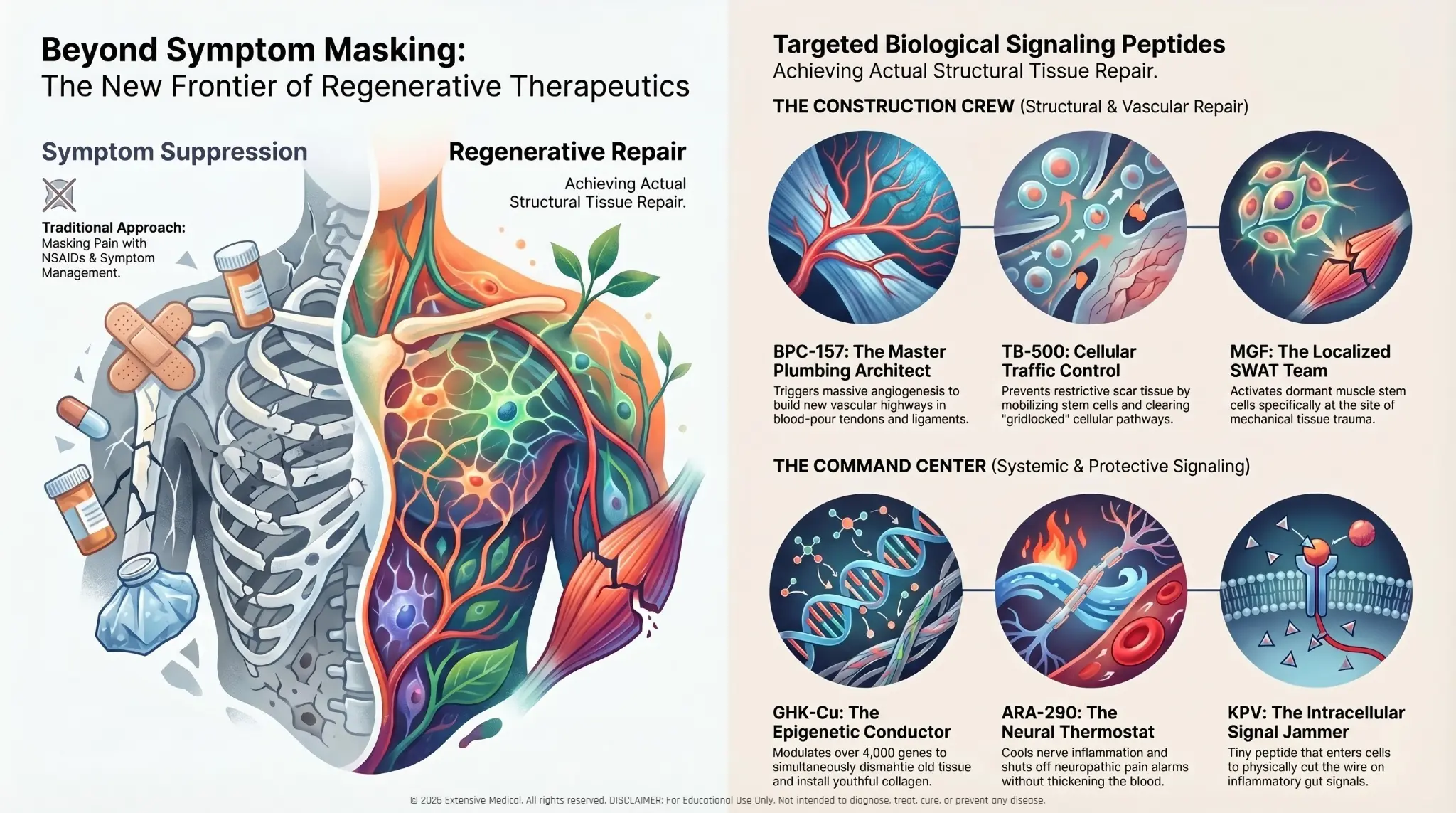
© 2026 Extensive Medical. All rights reserved. For educational use by licensed healthcare practitioners only.
Note: BPC-157 and TB-500 carry an absolute contraindication for patients with active malignancies or a history of cancer due to their potent angiogenic and cell-migratory properties. Both are also prohibited by WADA for competitive athletes.
Therapeutics in This Group
BPC-157
Body Protection Compound-157
Mechanism of Action
Powerfully activates the VEGFR2-Akt-eNOS signaling pathway, triggering massive angiogenesis (creation of new blood vessels). Also selectively modulates the Nitric Oxide system and upregulates growth hormone receptors directly at the site of tissue damage.
Target System
Vascular system, musculoskeletal system, and gastrointestinal mucosa
Clinical Use
Tendons, ligaments, and gut mucosal lining have terrible blood supply, making them incredibly slow to heal. BPC-157 solves avascular healing by physically building new vascular highways to the injury.
Key Benefits
- Radically accelerated healing of torn muscles, ligaments, and tendons
- Profound cytoprotective healing of stomach ulcers and colitis
- Neurological damage repair
- Oral bioavailability (Arginate Salt formulation)
Key Differentiator
The Arginate Salt formulation survives degradation in gastric acid, giving it over 90% oral bioavailability for targeted gut healing — whereas standard peptides are destroyed in the stomach.
The Analogy
"BPC-157 is the master contractor and plumbing architect of a biological construction site. It physically builds new vascular pipelines directly to the disaster zone so the construction crews can finally do their job."
TB-500
Thymosin Beta-4 Fragment
Mechanism of Action
Regulates actin, the vital structural protein forming the internal skeleton of cells. By binding to G-actin and preventing rigid polymerization into F-actin, it controls cell shape, movement, and migration — allowing repair cells to travel systemically to injury sites.
Target System
Cellular cytoskeleton, immune system, and musculoskeletal system
Clinical Use
Used to solve the problem of fibrotic, stiff scar tissue formation after severe trauma, surgery, or cardiac events.
Key Benefits
- Accelerated wound healing
- Massive mobilization of stem cells to injury sites
- Drastic reduction of fibrotic scarring
- Restored flexibility and range of motion
Key Differentiator
While BPC-157 focuses on blood flow (plumbing), TB-500 focuses on cellular migration (mobilizing the workforce). Often stacked together as the 'Wolverine Stack.'
The Analogy
"TB-500 acts as the body's advanced traffic control system for cellular highways. After trauma, roads become gridlocked with inflammation and scar tissue. TB-500 changes all the red lights to green, clearing the lanes for repair vehicles."
GHK-Cu
Copper Peptide
Mechanism of Action
Acts as a master epigenetic regulator, modulating the expression of over 4,000 human genes. By delivering copper directly to tissue-repair enzymes, it simultaneously downregulates inflammatory genes while upregulating genes responsible for collagen, elastin, and glycosaminoglycan synthesis.
Target System
Extracellular matrix (ECM), integumentary system (skin), and systemic antioxidant pathways
Clinical Use
Used for accelerated skin aging, poor wound healing, hair loss, and chronic systemic inflammation.
Key Benefits
- Massive stimulation of collagen production
- Physical breakdown of abnormal scar tissue
- Profound antioxidant defense
- Broad genetic reach
Key Differentiator
Incredibly broad genetic reach and reliance on copper chelation to trigger tissue remodeling — one of the safest and most effective systemic and cosmetic peptides available.
The Analogy
"GHK-Cu is the foreman broadcasting over the genetic communication network. It sends a synchronized, system-wide memo to over 4,000 different genetic departments — demolish old scaffolding and install new, youthful supports."
AHK
Alanine-Histidine-Lysine
Mechanism of Action
Stimulates local growth factors, promotes massive proliferation of fibroblasts and endothelial cells, and specifically extends the anagen (active growth) phase of hair follicles.
Target System
Epidermis and follicular architecture of the scalp
Clinical Use
Used for alopecia, thinning hair, and sluggish superficial wound healing.
Key Benefits
- Reactivation of dormant hair follicles
- Thicker hair shaft production
- Accelerated epidermal repair
- Minimal systemic absorption
Key Differentiator
Specific, proven affinity for the scalp and hair follicle reactivation — preferred over harsh chemicals like minoxidil without systemic cardiovascular side effects.
The Analogy
"AHK functions as a specialized fuel pump designed exclusively for the cellular engines of the scalp. When follicles have run out of gas and stalled, AHK reconnects the fuel lines and floods those specific engines with energy."
MGF / PEG-MGF
Mechano Growth Factor
Mechanism of Action
A unique splice variant of IGF-1 that is activated by mechanical stress. When muscle is physically torn or intensely exercised, MGF binds to receptors to activate muscle satellite cells (dormant stem cells), stimulating them to divide and rapidly repair torn muscle fibers. PEG-MGF has extended half-life.
Target System
Local skeletal muscle tissue, cardiac tissue, and cartilage
Clinical Use
Used for severe muscle trauma, age-related muscle wasting (sarcopenia), and delayed recovery in post-surgical orthopedic patients.
Key Benefits
- Dramatic localized muscle fiber repair
- Satellite cell activation
- Cartilage protection under mechanical load
- Isolated repair signal without systemic growth factors
Key Differentiator
Isolates the local repair signal of IGF-1 without flooding the entire body with systemic growth factors — preventing unwanted organ growth or blood sugar alterations.
The Analogy
"MGF is a localized emergency dispatch network. It lies dormant until it detects a mechanical 'crash.' Once the alarm trips, it immediately routes specialized emergency responders (satellite cells) directly to the site to rebuild broken muscle fibers."
AICAR
AMP Analogue — AMPK Activator
Mechanism of Action
Enters the cell and directly stimulates AMPK, the body's master energy sensor. By artificially activating AMPK, it tricks the cell into believing it is entirely depleted of energy, forcing it into a highly protective, catabolic state — burning fat, reducing inflammation, and increasing blood flow.
Target System
Cardiovascular system, cellular mitochondria, and autoimmune inflammatory pathways
Clinical Use
Used to protect the heart muscle following a heart attack (myocardial infarction) and to manage severe autoimmune inflammatory conditions.
Key Benefits
- Profound cardiac protection during low oxygen
- Improved metabolic regulation
- Slowing of physiological aging
- Extreme antioxidant properties
Key Differentiator
Chemically forces AMPK activation by mimicking a severe energy deficit — instantly shifting the cell into survival mode without requiring physical exertion.
The Analogy
"AICAR is the low-fuel sensor and emergency backup generator for the cellular engine. During a crisis, it tricks the engine's computer into thinking it has zero fuel left, kicking on highly efficient backup generators."
ARA-290
Non-Erythropoietic EPO Variant
Mechanism of Action
Selectively binds to the Innate Repair Receptor (IRR), which is expressed heavily during tissue injury. Ingeniously designed to bypass red-blood-cell-producing pathways and only activate the tissue-repair and anti-inflammatory pathways of the IRR.
Target System
Peripheral nervous system and innate immune system
Clinical Use
Used for neuropathic pain such as diabetic neuropathy or small fiber neuropathy — where high blood sugar chronically inflames and kills peripheral nerves.
Key Benefits
- Rapid down-regulation of inflammatory cytokines in nerve tissue
- Dramatic modulation of chronic neuropathic pain
- Actual stimulation of nerve repair
- Improvements in HbA1c and cholesterol
Key Differentiator
Provides the profound neuroprotective and healing benefits of EPO without the dangerous cardiovascular risk of thickening the blood.
The Analogy
"ARA-290 acts as a cellular thermostat and fire extinguisher for the peripheral nervous system — dialing down the inflammatory thermostat, cooling the wires, and shutting off the neuropathic pain alarm at its biological source."
B7-33
H2 Relaxin-Derived Anti-Fibrotic
Mechanism of Action
Binds to relaxin receptors to actively inhibit the excessive deposition of collagen and extracellular matrix proteins that occur after severe tissue injury — directly interrupting the scarring cascade.
Target System
Cardiovascular, renal (kidney), and pulmonary (lung) systems
Clinical Use
Used to solve the deadly problem of organ fibrosis following heart attacks, severe lung inflammation, or chronic kidney disease.
Key Benefits
- Documented 50% reduction in fibrosis in animal models
- Significantly prolonged survival following cardiac injury
- Preservation of mechanical organ function
- First new approach to heart failure in 20 years
Key Differentiator
Not just an anti-inflammatory — it is an active anti-fibrotic, directly interrupting the scarring cascade and the overproduction of collagen.
The Analogy
"B7-33 is the anti-concrete inspector on a biological construction site. It interrupts the construction crew, halts the pouring of stiff, rigid concrete (fibrotic scar tissue), and forces them to use flexible, functional building materials instead."
KPV
Lysine-Proline-Valine
Mechanism of Action
Because it is so incredibly small, it easily crosses cell membranes and works intracellularly. Once inside, it directly blocks the NF-kB pathway — the master genetic switch that triggers massive inflammatory cytokine responses — profoundly suppressing TNF-alpha and IL-6.
Target System
Immune system, integumentary system (skin), and intestinal mucosa
Clinical Use
Prescribed for Inflammatory Bowel Disease (Crohn's disease and Ulcerative Colitis), leaky gut syndrome, and severe inflammatory skin conditions like psoriasis.
Key Benefits
- Rapid, potent reduction of intestinal inflammation
- Healing and stabilization of mucosal lining
- Accelerated wound healing with non-scarring results
- Intracellular suppression of the inflammation switch
Key Differentiator
Intracellular suppression of the exact switch that causes inflammation — without completely shutting down the entire immune system like heavy biologic drugs or steroids.
The Analogy
"KPV is a micro-thermostat and signal jammer. It slips right inside the cell and jams the NF-kB communication network — the master alarm switch — instantly cooling down the overheated environment of the gut."
Medical Disclaimer: The information on this page is provided for educational and informational purposes only and is not intended as medical advice, diagnosis, or treatment. Statements regarding peptides and related compounds have not necessarily been evaluated by the U.S. Food and Drug Administration (FDA), and no claim is being made that any product or therapy referenced is FDA approved for the uses discussed. Always consult your licensed healthcare provider before starting, stopping, or changing any treatment, supplement, medication, or wellness protocol. Read our full Medical Disclaimer.