
Skin & Aesthetics
Dermal Bioregulation & Aesthetic Medicine
Advanced Medical Peptide Aesthetics and Dermatological Bioregulation
Video Training — Group 8: Skin & Aesthetics
Overview
This module moves beyond cosmetic creams into advanced dermal systems biology. We shift from harsh, destructive aesthetic treatments — chemical peels, aggressive lasers, and retinoids that force cellular turnover through irritation — to utilizing biological signaling to instruct the skin's own cells to rebuild, regenerate, and restore youthful architecture. Seven precision aesthetic therapeutics are covered.
Group Overview Infographic
Visual reference for all therapeutics in the Skin & Aesthetics group
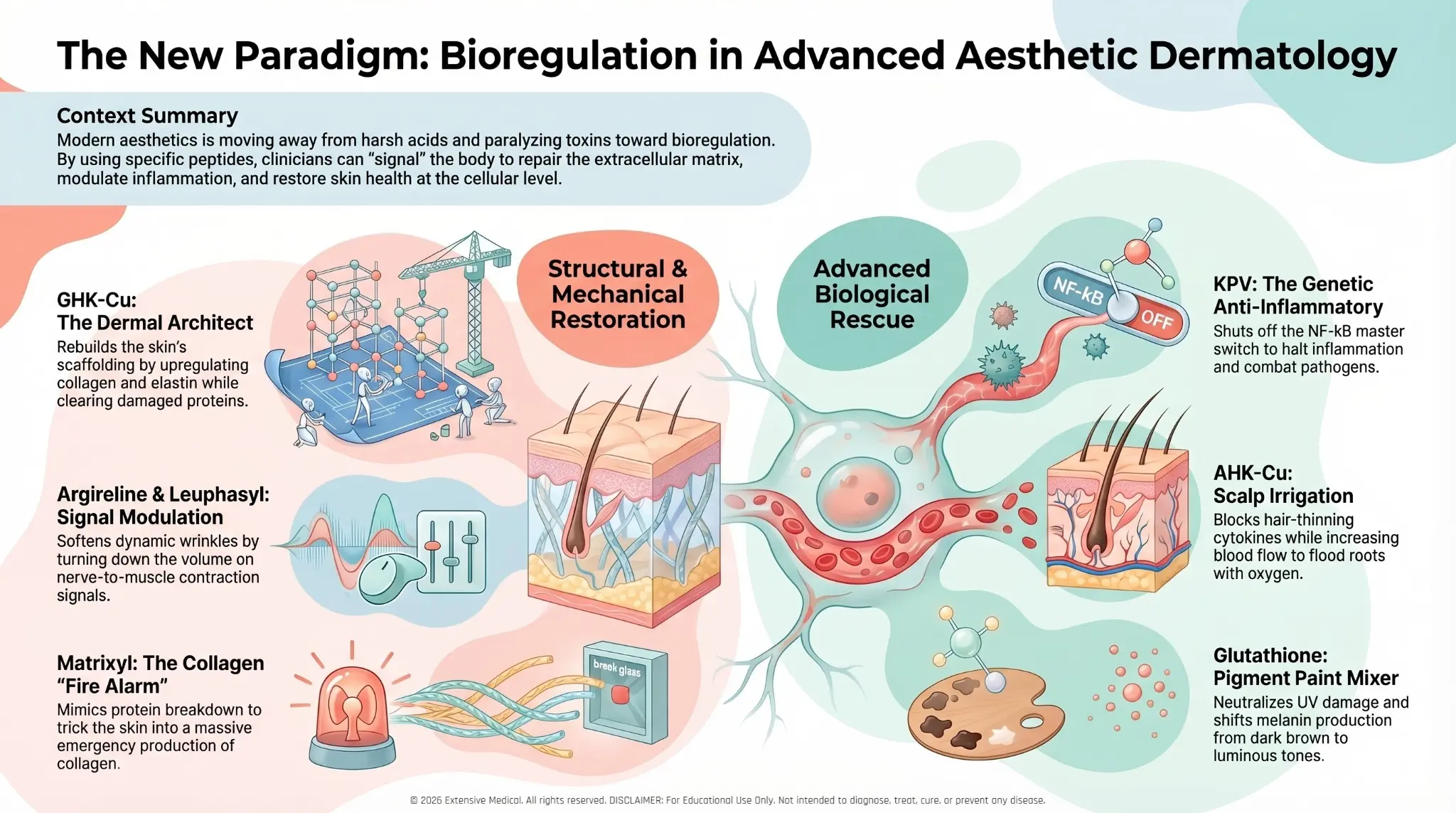
© 2026 Extensive Medical. All rights reserved. For educational use by licensed healthcare practitioners only.
Therapeutics in This Group
GHK-Cu
Copper Peptide — Topical Application
Mechanism of Action
Acts as a master epigenetic regulator, modulating the expression of over 4,000 human genes. Delivers copper directly to tissue-repair enzymes, simultaneously downregulating inflammatory genes while upregulating genes responsible for collagen, elastin, and glycosaminoglycan synthesis.
Target System
Extracellular matrix (ECM), dermal fibroblasts, and antioxidant pathways
Clinical Use
Used for accelerated skin aging, poor wound healing, photo-damage, and as a foundational anti-aging topical in aesthetic medicine protocols.
Key Benefits
- Massive collagen stimulation
- Breakdown of abnormal scar tissue
- Profound antioxidant defense
- Decades of topical safety data
Key Differentiator
Incredibly broad genetic reach — signals the DNA directly to naturally reorganize the extracellular matrix without inflammatory damage.
The Analogy
"GHK-Cu is the foreman broadcasting over the genetic communication network — sending a synchronized memo to over 4,000 genetic departments to demolish old scaffolding and install new, youthful supports."
Argireline
Acetyl Hexapeptide-8 — Topical Botox Alternative
Mechanism of Action
A synthetic hexapeptide that inhibits the SNARE protein complex — the same mechanism used by botulinum toxin (Botox) — preventing the release of neurotransmitters at the neuromuscular junction. This relaxes facial muscles and reduces the formation of expression lines.
Target System
Neuromuscular junction — SNARE protein complex
Clinical Use
Used as a topical alternative or adjunct to Botox for reducing expression lines, crow's feet, and forehead wrinkles.
Key Benefits
- Topical muscle relaxation
- Reduction of expression lines
- Non-invasive Botox alternative
- No injection required
Key Differentiator
Provides the muscle-relaxing mechanism of Botox through a topical peptide — no needles, no downtime, no risk of migration.
The Analogy
"Argireline is the topical volume control for facial muscle contractions — it turns down the intensity of the neuromuscular signal that causes expression lines to form."
Leuphasyl
Pentapeptide-18 — Enkephalin Analogue
Mechanism of Action
A synthetic pentapeptide that mimics the action of enkephalins — natural opioid peptides in the skin. Binds to opioid receptors at the neuromuscular junction to reduce the intensity of muscle contractions, complementing the SNARE-inhibiting action of Argireline.
Target System
Neuromuscular junction — enkephalin receptor system
Clinical Use
Used in combination with Argireline for enhanced wrinkle reduction — the two compounds work through complementary mechanisms for synergistic anti-wrinkle effects.
Key Benefits
- Complementary wrinkle reduction
- Synergistic with Argireline
- Enkephalin receptor mechanism
- Enhanced expression line reduction
Key Differentiator
Works through a completely different receptor system than Argireline — the combination of both provides synergistic wrinkle reduction that neither achieves alone.
The Analogy
"Leuphasyl is the second brake on facial muscle contractions. While Argireline blocks the accelerator signal, Leuphasyl activates the brake — together they provide maximum control over expression line formation."
Matrixyl
Palmitoyl Pentapeptide-4 — Collagen Stimulator
Mechanism of Action
A palmitoylated pentapeptide that mimics a fragment of collagen. When the skin detects this fragment, it interprets it as a signal that collagen has been broken down — triggering fibroblasts to dramatically increase collagen, elastin, and hyaluronic acid production.
Target System
Dermal fibroblasts — collagen, elastin, and hyaluronic acid synthesis
Clinical Use
Used as a foundational anti-aging ingredient for stimulating collagen production and improving skin firmness, elasticity, and hydration.
Key Benefits
- Dramatic collagen stimulation
- Improved skin firmness and elasticity
- Increased hyaluronic acid production
- Extensive clinical safety data
Key Differentiator
One of the most extensively studied and clinically validated topical peptides — with decades of safety and efficacy data in aesthetic medicine.
The Analogy
"Matrixyl is the false alarm that triggers the right response. It tricks the skin into thinking collagen has been damaged, causing fibroblasts to rush in and produce new collagen, elastin, and hyaluronic acid."
AHK-Cu
Alanine-Histidine-Lysine Copper — Scalp and Skin
Mechanism of Action
A copper-chelating tripeptide that combines the follicular reactivation properties of AHK with the copper-dependent enzyme activation of GHK-Cu. Specifically targets hair follicles and superficial skin tissue.
Target System
Hair follicles and superficial skin — follicular and epidermal repair
Clinical Use
Used for hair loss, thinning hair, and superficial skin repair — particularly in aesthetic protocols combining scalp and facial rejuvenation.
Key Benefits
- Hair follicle reactivation
- Copper-dependent tissue repair
- Scalp and skin synergy
- Anagen phase extension
Key Differentiator
Combines the follicular specificity of AHK with the copper-dependent repair mechanisms of GHK-Cu — a dual-action compound for scalp and skin.
The Analogy
"AHK-Cu is the specialized fuel pump for the scalp's cellular engines, enhanced with copper-dependent repair tools — reconnecting fuel lines to dormant follicles while simultaneously repairing the surrounding tissue."
KPV
Lysine-Proline-Valine — Topical Anti-Inflammatory
Mechanism of Action
A tiny tripeptide derived from alpha-MSH that crosses cell membranes and works intracellularly to block the NF-kB pathway — the master genetic switch for inflammatory cytokine production. Profoundly suppresses TNF-alpha and IL-6 in skin tissue.
Target System
Skin immune cells — NF-kB inflammatory pathway
Clinical Use
Used topically for inflammatory skin conditions including psoriasis, eczema, rosacea, and post-procedure inflammation.
Key Benefits
- Potent topical anti-inflammatory
- NF-kB pathway suppression
- Accelerated wound healing
- Non-scarring results
Key Differentiator
Intracellular suppression of the exact inflammation switch — without the skin thinning and side effects of topical corticosteroids.
The Analogy
"KPV is the micro-thermostat for skin inflammation — it slips inside the cell and jams the master alarm switch, instantly cooling down the overheated skin environment."
Glutathione
Master Antioxidant — Aesthetic and Systemic
Mechanism of Action
The body's most abundant endogenous antioxidant — a tripeptide (Glu-Cys-Gly) that neutralizes free radicals, regenerates other antioxidants (Vitamins C and E), and inhibits melanin synthesis through tyrosinase inhibition.
Target System
Systemic antioxidant defense and melanin synthesis pathways
Clinical Use
Used for skin brightening, hyperpigmentation, oxidative stress reduction, and as a systemic anti-aging and detoxification compound.
Key Benefits
- Skin brightening and hyperpigmentation reduction
- Systemic antioxidant defense
- Regeneration of Vitamins C and E
- Detoxification support
Key Differentiator
The body's own master antioxidant — provides both aesthetic brightening and systemic antioxidant defense through a single endogenous compound.
The Analogy
"Glutathione is the body's master janitor and security guard — it neutralizes the free radical vandals that damage cells while simultaneously cleaning up the oxidative mess they leave behind."
Medical Disclaimer: The information on this page is provided for educational and informational purposes only and is not intended as medical advice, diagnosis, or treatment. Statements regarding peptides and related compounds have not necessarily been evaluated by the U.S. Food and Drug Administration (FDA), and no claim is being made that any product or therapy referenced is FDA approved for the uses discussed. Always consult your licensed healthcare provider before starting, stopping, or changing any treatment, supplement, medication, or wellness protocol. Read our full Medical Disclaimer.