
Brain & Cognition
Neuroprotection & Cognitive Enhancement
Advanced Neurocognitive Peptide Therapeutics
Video Training — Group 4: Brain & Cognition
Overview
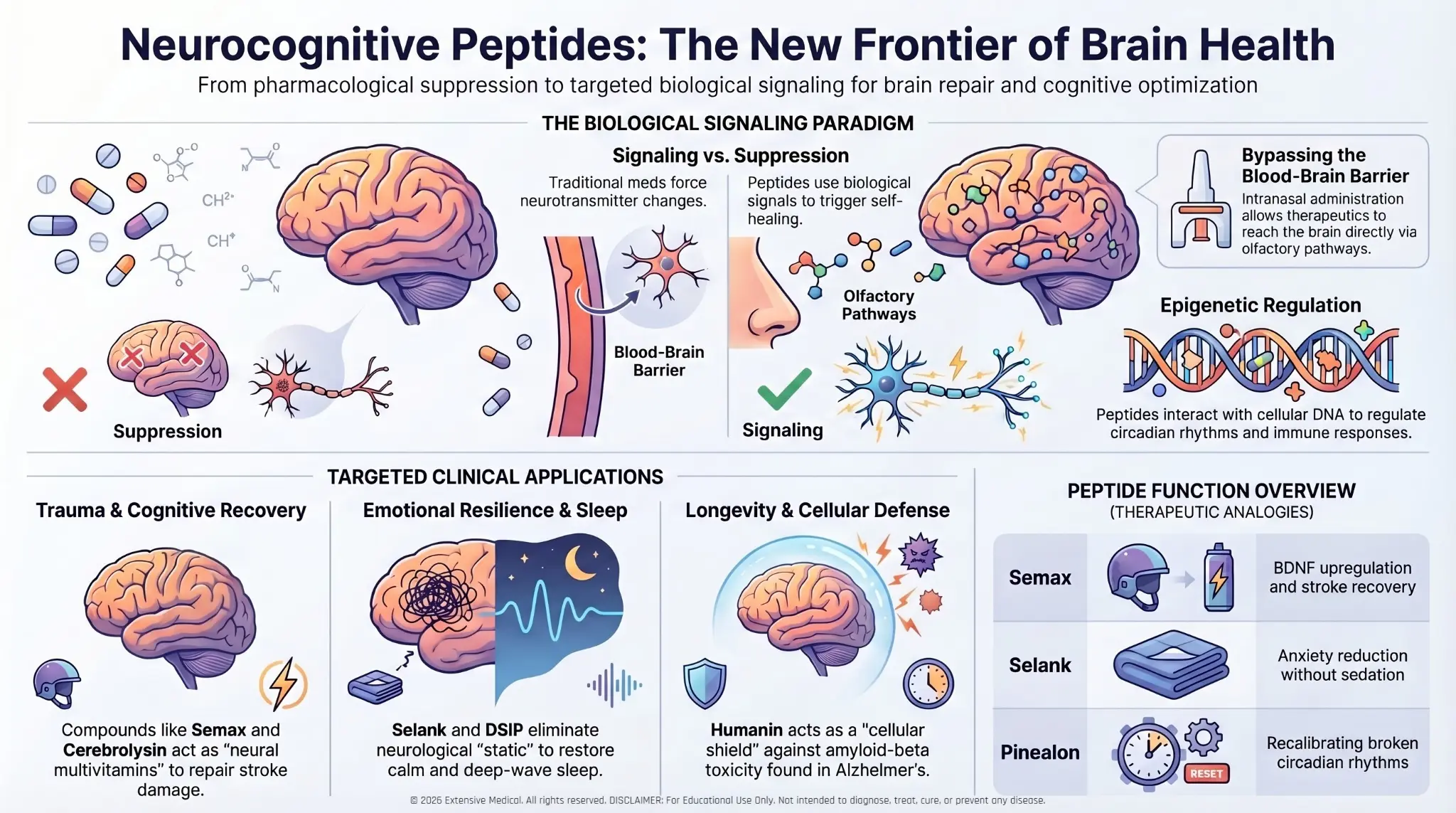
This module explores the neurocognitive frontier — peptides that accelerate neural repair, enhance neuroplasticity, and restore cognitive homeostasis. We shift from forcing the brain into submission with SSRIs, benzodiazepines, or amphetamine-based stimulants, to utilizing biological signaling to restore the brain's natural capacity to heal and optimize itself. Nine highly specific neurocognitive therapeutics are covered.
Group Overview Infographic
Visual reference for all therapeutics in the Brain & Cognition group
© 2026 Extensive Medical. All rights reserved. For educational use by licensed healthcare practitioners only.
Therapeutics in This Group
Semax
ACTH-Derived Neuropeptide
Mechanism of Action
A synthetic analogue of ACTH (adrenocorticotropic hormone) that powerfully increases BDNF (Brain-Derived Neurotrophic Factor) and NGF (Nerve Growth Factor). These are the brain's own fertilizers for growing new neural connections and repairing damaged ones.
Target System
Central nervous system — BDNF and NGF pathways
Clinical Use
Used for stroke recovery, traumatic brain injury, ADHD, anxiety, and cognitive decline — particularly where neuroplasticity and neural repair are needed.
Key Benefits
- Massive increase in BDNF and NGF
- Enhanced neuroplasticity
- Improved focus and memory
- Neuroprotection and stroke recovery
Key Differentiator
Directly stimulates the brain's own growth factors — not a stimulant, not a sedative, but a true neural repair and optimization signal.
The Analogy
"Semax is the brain's fertilizer delivery system. While stimulants force the existing crops to grow faster and burn out, Semax plants new seeds and improves the soil quality of the entire neural garden."
Selank
N-Acetyl Selank Amidate
Mechanism of Action
A synthetic analogue of the naturally occurring immunomodulatory peptide tuftsin. Modulates the expression of serotonin, dopamine, and GABA — the brain's primary calming neurotransmitter — while also increasing BDNF.
Target System
Central nervous system — serotonin, dopamine, and GABA systems
Clinical Use
Used for anxiety, depression, PTSD, and cognitive enhancement — particularly in patients who need anxiolytic effects without the dependency and sedation of benzodiazepines.
Key Benefits
- Profound anxiolytic effects
- No dependency or withdrawal
- Enhanced memory and learning
- Mood stabilization
Key Differentiator
Provides the calming effects of benzodiazepines through a completely different, non-addictive mechanism — modulating GABA without binding to benzodiazepine receptors.
The Analogy
"Selank is the brain's natural volume control for anxiety. Instead of chemically forcing the anxiety circuits offline (like benzos), it gently turns down the gain on the stress response system."
Cerebrolysin
Neuropeptide Complex
Mechanism of Action
A complex mixture of low-molecular-weight neuropeptides and amino acids derived from pig brain tissue. Mimics the action of endogenous neurotrophic factors — stimulating neuronal survival, differentiation, and synaptic plasticity.
Target System
Central and peripheral nervous system — neurotrophic factor pathways
Clinical Use
Used for Alzheimer's disease, vascular dementia, stroke recovery, and traumatic brain injury — one of the most extensively studied neuroprotective compounds in the world.
Key Benefits
- Extensive clinical trial database
- Neuronal survival and differentiation
- Improved cognitive function in dementia
- Synaptic plasticity enhancement
Key Differentiator
One of the most extensively studied neuroprotective compounds globally — with decades of clinical data in Alzheimer's and stroke recovery.
The Analogy
"Cerebrolysin is the brain's comprehensive repair kit — a complex mixture of the exact biological tools the brain uses to maintain and rebuild its own neural architecture."
Pinealon
Pineal Gland Bioregulator
Mechanism of Action
A tripeptide bioregulator specifically designed for the pineal gland. Penetrates the blood-brain barrier and acts as an epigenetic tuner for pineal cells, restoring their ability to produce melatonin and regulate the circadian rhythm.
Target System
Pineal gland — circadian rhythm and melatonin production
Clinical Use
Used for severe sleep disorders, circadian rhythm disruption, and age-related cognitive decline associated with declining melatonin production.
Key Benefits
- Restored melatonin production
- Improved sleep architecture
- Circadian rhythm regulation
- Neuroprotective effects
Key Differentiator
Targets the root cause of age-related sleep disruption — the declining function of the pineal gland itself — rather than simply supplementing melatonin.
The Analogy
"Pinealon is the maintenance technician for the brain's internal clock. Instead of manually setting the clock (melatonin supplementation), it repairs the clock mechanism so it runs accurately on its own."
DSIP
Delta Sleep-Inducing Peptide
Mechanism of Action
A naturally occurring neuropeptide that promotes delta-wave (deep) sleep by modulating the activity of the hypothalamic sleep centers. Also has stress-protective and antioxidant properties.
Target System
Hypothalamic sleep centers and stress response systems
Clinical Use
Used for insomnia, sleep architecture disruption, and stress-related disorders — particularly in patients with poor slow-wave sleep.
Key Benefits
- Promotes deep delta-wave sleep
- Stress-protective effects
- Antioxidant properties
- Non-habit-forming sleep support
Key Differentiator
Promotes the specific type of sleep (delta-wave) that is most restorative — rather than simply inducing sedation like traditional sleep medications.
The Analogy
"DSIP is the conductor that guides the brain's orchestra into the deep, slow movements of restorative sleep — not a sledgehammer that forces unconsciousness."
PE-22-28
TREK-1 Channel Inhibitor
Mechanism of Action
A synthetic peptide that inhibits the TREK-1 potassium channel in the brain. TREK-1 is a key regulator of serotonin signaling — by inhibiting it, PE-22-28 significantly increases serotonin availability in the synapse.
Target System
Central nervous system — TREK-1 channel and serotonin system
Clinical Use
Used for treatment-resistant depression — particularly in patients who have not responded adequately to traditional SSRIs.
Key Benefits
- Rapid antidepressant effects
- Novel mechanism distinct from SSRIs
- Potential for treatment-resistant depression
- Neuroplasticity enhancement
Key Differentiator
Works through a completely novel mechanism — inhibiting TREK-1 rather than blocking serotonin reuptake — providing an option for SSRI non-responders.
The Analogy
"PE-22-28 is like removing a dam from the serotonin river. Instead of trying to pump more water upstream (SSRIs), it removes the blockage that was preventing natural flow."
Cortagen
Cortex Bioregulator
Mechanism of Action
A tetrapeptide bioregulator specifically designed for the cerebral cortex. Penetrates the blood-brain barrier and acts as an epigenetic tuner for cortical neurons, restoring their natural gene expression and improving neuronal efficiency.
Target System
Cerebral cortex — cortical neuron function and gene expression
Clinical Use
Used for age-related cognitive decline, cortical dysfunction, and neurological recovery following brain injury.
Key Benefits
- Restored cortical neuron function
- Improved cognitive performance
- Neuroprotective effects
- Epigenetic cortical repair
Key Differentiator
Specifically targets the cerebral cortex — the seat of higher cognitive function — with organ-specific epigenetic precision.
The Analogy
"Cortagen is the IT specialist for the brain's operating system. It doesn't just run a patch — it restores the original code so the cortex can run its programs at full efficiency again."
Humanin
Mitochondrial-Derived Neuropeptide
Mechanism of Action
A small peptide encoded in the mitochondrial genome that provides powerful neuroprotection by inhibiting neuronal apoptosis (programmed cell death). Also improves insulin sensitivity in the brain and reduces neuroinflammation.
Target System
Central nervous system — mitochondrial neuroprotection pathways
Clinical Use
Used for Alzheimer's disease prevention, age-related cognitive decline, and neurological conditions associated with mitochondrial dysfunction.
Key Benefits
- Potent neuroprotection against apoptosis
- Improved brain insulin sensitivity
- Reduced neuroinflammation
- Mitochondrial support
Key Differentiator
Derived from the mitochondrial genome — a completely different origin than nuclear-encoded peptides — providing unique mitochondrial-level neuroprotection.
The Analogy
"Humanin is the brain's emergency shutdown prevention system. When neurons are about to self-destruct due to stress or disease, Humanin steps in and overrides the self-destruct sequence."
Oxytocin
The Social Bonding Neuropeptide
Mechanism of Action
A naturally occurring neuropeptide produced in the hypothalamus that acts on oxytocin receptors throughout the brain and body. Modulates social bonding, trust, empathy, stress response, and pain perception.
Target System
Central nervous system and peripheral tissues — oxytocin receptor system
Clinical Use
Used for social anxiety, autism spectrum disorder, PTSD, and as an adjunct in couples therapy and trauma recovery.
Key Benefits
- Enhanced social bonding and trust
- Reduced anxiety and stress response
- Improved pain tolerance
- Therapeutic applications in autism and PTSD
Key Differentiator
The only neuropeptide that directly modulates the social bonding and trust circuitry of the brain — a unique target not addressed by any other therapeutic class.
The Analogy
"Oxytocin is the brain's social lubricant — it reduces the friction in human connection by turning down the threat-detection system and turning up the trust and empathy circuits."
Medical Disclaimer: The information on this page is provided for educational and informational purposes only and is not intended as medical advice, diagnosis, or treatment. Statements regarding peptides and related compounds have not necessarily been evaluated by the U.S. Food and Drug Administration (FDA), and no claim is being made that any product or therapy referenced is FDA approved for the uses discussed. Always consult your licensed healthcare provider before starting, stopping, or changing any treatment, supplement, medication, or wellness protocol. Read our full Medical Disclaimer.