
Anti-Aging & Longevity
Cellular Longevity & Biological Restoration
Advanced Anti-Aging, Cellular Longevity, and Bioregulation
Video Training — Group 6: Anti-Aging & Longevity
Overview
This module explores the absolute pinnacle of regenerative medicine — anti-aging and longevity therapeutics. We shift from treating aging as a collection of inevitable symptoms to targeting the actual root causes: mitochondrial dysfunction, genomic instability, telomere shortening, and cellular senescence. Ten highly specific therapeutics are covered, from foundational cellular energetics to advanced epigenetic bioregulators.
Group Overview Infographic
Visual reference for all therapeutics in the Anti-Aging & Longevity group
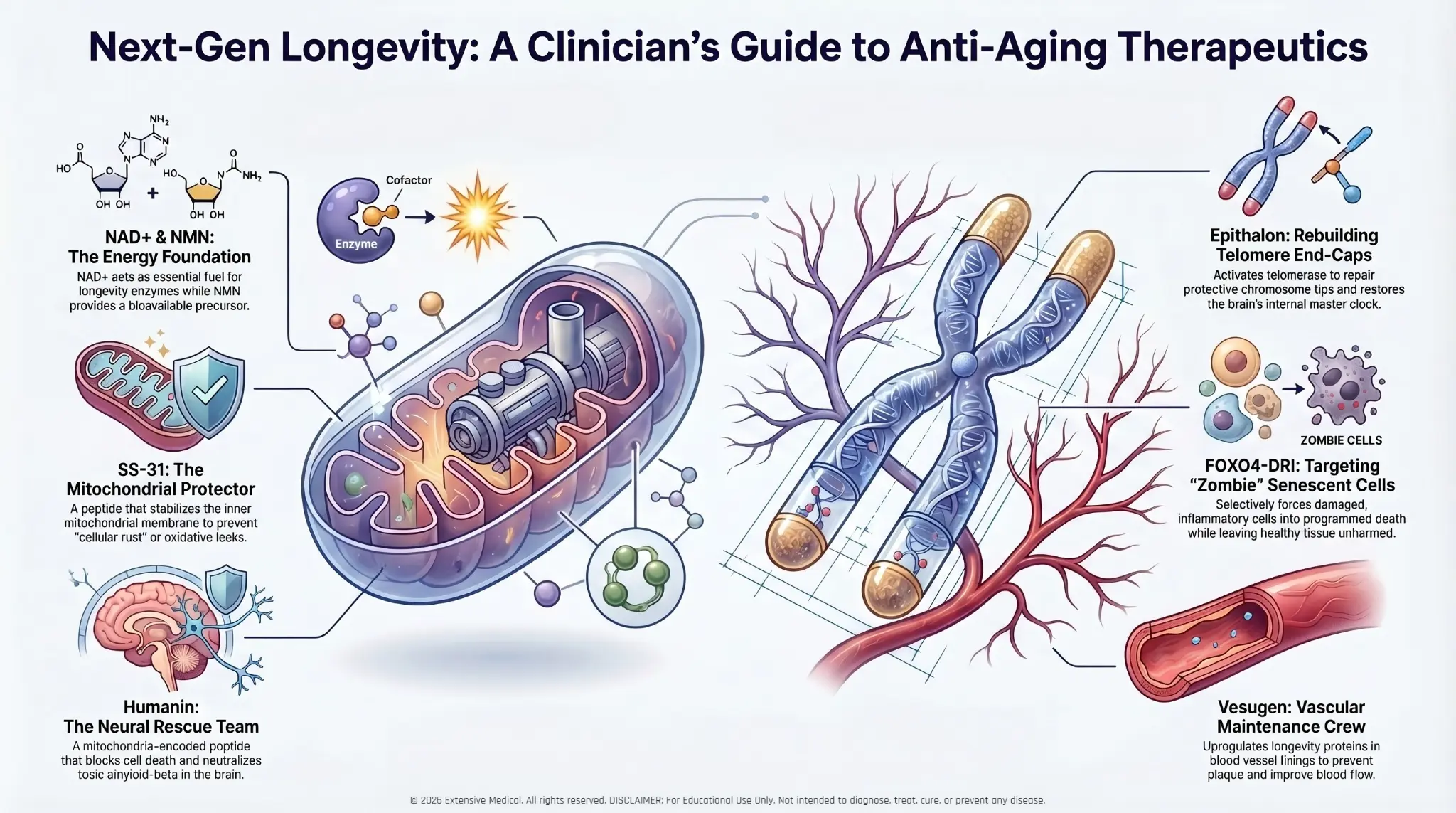
© 2026 Extensive Medical. All rights reserved. For educational use by licensed healthcare practitioners only.
Therapeutics in This Group
NAD+
Nicotinamide Adenine Dinucleotide
Mechanism of Action
Acts as a redox electron carrier for ATP synthesis and as a mandatory co-substrate for Sirtuin longevity enzymes and PARP DNA-repair enzymes. NAD+ levels decline dramatically after the mid-thirties, driving cellular aging.
Target System
Cellular energetics, mitochondrial function, and genomic stability
Clinical Use
Prescribed to restore the foundational infrastructure of the cell — the absolute prerequisite that makes every other peptide or metabolic therapy work more efficiently.
Key Benefits
- Systemic cellular rejuvenation
- Sirtuin longevity pathway activation
- DNA repair
- Profound anti-aging effects
Key Differentiator
The literal biochemical fuel required for life — not a symptom manager but a foundational cellular restoration compound.
The Analogy
"NAD+ is like the electricity running through the wiring of a house. Every appliance depends on it. If the power plant output drops, nothing works correctly."
NMN
Nicotinamide Mononucleotide
Mechanism of Action
A highly bioavailable Vitamin B3 derivative that enters the cell and is rapidly converted directly into NAD+ through the salvage pathway — raising systemic NAD+ levels from the inside out.
Target System
Cellular energy and longevity systems via the salvage pathway
Clinical Use
Provides a convenient daily oral protocol to maintain NAD+ levels and keep longevity pathways activated between clinical visits.
Key Benefits
- Daily compliance-friendly
- Suppresses age-associated weight gain
- Improves insulin sensitivity
- Sustained longevity pathway activation
Key Differentiator
Administration route and reliance on the body's internal conversion machinery — the preferred daily maintenance protocol for NAD+ optimization.
The Analogy
"NMN is like premium-grade crude oil that your body's refinery directly converts into electricity — fill the tank with high-quality fuel and let the engine do the conversion."
SS-31
Elamipretide / Forzinity
Mechanism of Action
A mitochondria-targeted peptide that selectively concentrates in the inner mitochondrial membrane. It stabilizes cardiolipin — a critical phospholipid that anchors the electron transport chain — dramatically improving mitochondrial efficiency and reducing oxidative stress.
Target System
Inner mitochondrial membrane — cardiolipin and electron transport chain
Clinical Use
Used for heart failure, age-related mitochondrial dysfunction, and conditions where mitochondrial energy production is critically impaired.
Key Benefits
- Mitochondrial membrane stabilization
- Dramatically improved ATP production
- Reduced oxidative stress
- Cardiac function improvement
Key Differentiator
The only peptide that directly targets the inner mitochondrial membrane — providing cardiolipin stabilization that no other compound can achieve.
The Analogy
"SS-31 is the structural engineer for the mitochondria's power plant — it stabilizes the scaffolding that holds the energy-generating machinery in place, preventing the entire structure from collapsing."
Humanin
Mitochondrial-Derived Longevity Peptide
Mechanism of Action
A small peptide encoded in the mitochondrial genome that provides powerful cytoprotection by inhibiting neuronal and cellular apoptosis. Also improves insulin sensitivity and reduces inflammation throughout the body.
Target System
Mitochondrial neuroprotection and systemic cytoprotection pathways
Clinical Use
Used for Alzheimer's prevention, age-related cognitive and metabolic decline, and conditions associated with mitochondrial dysfunction.
Key Benefits
- Potent cytoprotection against apoptosis
- Improved insulin sensitivity
- Reduced systemic inflammation
- Neuroprotection
Key Differentiator
Derived from the mitochondrial genome — a completely different origin than nuclear-encoded peptides — providing unique mitochondrial-level cytoprotection.
The Analogy
"Humanin is the emergency shutdown prevention system for cells. When cells are about to self-destruct due to stress or aging, Humanin overrides the self-destruct sequence."
Epithalon
Telomere Restoration Peptide
Mechanism of Action
A synthetic tetrapeptide analogue of Epithalamin (from the pineal gland). Activates telomerase — the enzyme that rebuilds telomeres — and acts as an epigenetic regulator that restores youthful gene expression patterns.
Target System
Telomere maintenance, pineal gland, and epigenetic regulation
Clinical Use
Used as a foundational anti-aging therapy to address the root cause of cellular aging — telomere shortening and the loss of youthful gene expression.
Key Benefits
- Telomerase activation
- Telomere length restoration
- Epigenetic rejuvenation
- Improved sleep and circadian regulation
Key Differentiator
One of the only compounds with documented telomere-lengthening effects in human studies — addressing the fundamental biological clock of aging.
The Analogy
"Epithalon is the biological clock repairman. Telomeres are the protective caps on chromosomes that shorten with every cell division. Epithalon activates the enzyme that rebuilds those caps — resetting the biological clock."
FOXO4-DRI
Senolytic Peptide
Mechanism of Action
A D-retro-inverso peptide that disrupts the interaction between FOXO4 and p53 in senescent cells. This interaction normally prevents senescent cells from undergoing apoptosis — FOXO4-DRI breaks this bond, allowing the body to clear out these 'zombie cells.'
Target System
Senescent cells — FOXO4/p53 interaction pathway
Clinical Use
Used as a senolytic therapy — specifically targeting and eliminating the senescent cells that accumulate with age and drive chronic inflammation and tissue dysfunction.
Key Benefits
- Selective elimination of senescent cells
- Reduced senescence-associated inflammation (SASP)
- Tissue rejuvenation
- Improved physical function
Key Differentiator
The most targeted senolytic peptide available — specifically disrupts the survival mechanism of senescent cells without harming healthy cells.
The Analogy
"FOXO4-DRI is the biological garbage collector for zombie cells. Senescent cells are like broken machinery that refuses to be shut down — FOXO4-DRI cuts the wire that keeps them running and allows the cleanup crew to remove them."
Vilon
Dipeptide Longevity Bioregulator
Mechanism of Action
A synthetic dipeptide (Lys-Glu) that acts as an epigenetic bioregulator for multiple tissues. Activates telomerase, promotes cellular longevity, and supports immune and vascular function simultaneously.
Target System
Multiple tissues — immune, vascular, and cellular aging pathways
Clinical Use
Used for broad anti-aging support, vascular health, and multi-system bioregulation in elderly patients.
Key Benefits
- Telomerase activation
- Broad multi-system support
- Vascular health
- Cellular longevity
Key Differentiator
Bridges immune modulation and cellular longevity in a single ultra-short peptide — one of the most versatile bioregulators available.
The Analogy
"Vilon is the biological maintenance crew that services multiple aging systems simultaneously — immune, vascular, and cellular — in a single, ultra-short peptide."
Livagen
Liver Bioregulator
Mechanism of Action
A tetrapeptide bioregulator specifically designed for hepatic (liver) tissue. Penetrates liver cells and acts as an epigenetic tuner, restoring the natural gene expression of hepatocytes and improving liver regenerative capacity.
Target System
Hepatic tissue — liver cell function and regeneration
Clinical Use
Used for age-related liver function decline, fatty liver disease, and as a supportive therapy in patients with hepatic dysfunction.
Key Benefits
- Restored hepatocyte function
- Improved liver regeneration
- Epigenetic liver repair
- Fatty liver support
Key Differentiator
Organ-specific epigenetic precision for the liver — the body's primary metabolic and detoxification organ.
The Analogy
"Livagen is the software update for the liver's operating system — restoring the original code so hepatocytes can perform their metabolic and detoxification functions at full capacity."
Vesugen
Vascular Bioregulator
Mechanism of Action
A tripeptide bioregulator specifically designed for vascular endothelial tissue. Penetrates endothelial cells and acts as an epigenetic tuner, restoring their natural gene expression and improving vascular elasticity and function.
Target System
Vascular endothelial tissue — endothelial cell function and elasticity
Clinical Use
Used for age-related vascular stiffness, atherosclerosis, and as a preventive therapy for cardiovascular decline.
Key Benefits
- Restored endothelial function
- Improved vascular elasticity
- Cardiovascular protection
- Epigenetic vascular repair
Key Differentiator
Organ-specific epigenetic precision for the vascular system — targeting the endothelial cells that line every blood vessel in the body.
The Analogy
"Vesugen is the maintenance crew for the body's plumbing system — restoring the flexibility and function of the pipes (blood vessels) that have become stiff and calcified with age."
Cartalax
Cartilage & Connective Tissue Bioregulator
Mechanism of Action
A tripeptide bioregulator specifically designed for cartilage and connective tissue. Penetrates chondrocytes and acts as an epigenetic tuner, restoring their natural gene expression and improving cartilage synthesis and repair.
Target System
Cartilage and connective tissue — chondrocyte function
Clinical Use
Used for osteoarthritis, age-related cartilage degeneration, and as a supportive therapy for joint health.
Key Benefits
- Restored chondrocyte function
- Improved cartilage synthesis
- Joint health support
- Epigenetic cartilage repair
Key Differentiator
Organ-specific epigenetic precision for cartilage — targeting the chondrocytes that produce and maintain cartilage matrix.
The Analogy
"Cartalax is the restoration specialist for the body's shock absorbers — reactivating the cells that produce cartilage so they can rebuild the cushioning that has worn away with age."
Medical Disclaimer: The information on this page is provided for educational and informational purposes only and is not intended as medical advice, diagnosis, or treatment. Statements regarding peptides and related compounds have not necessarily been evaluated by the U.S. Food and Drug Administration (FDA), and no claim is being made that any product or therapy referenced is FDA approved for the uses discussed. Always consult your licensed healthcare provider before starting, stopping, or changing any treatment, supplement, medication, or wellness protocol. Read our full Medical Disclaimer.