
Hormone & Endocrine
Endocrine Restoration & Hormonal Signaling
Mastering Hormone and Endocrine Peptide Therapeutics
Video Training — Group 7: Hormone & Endocrine
Overview
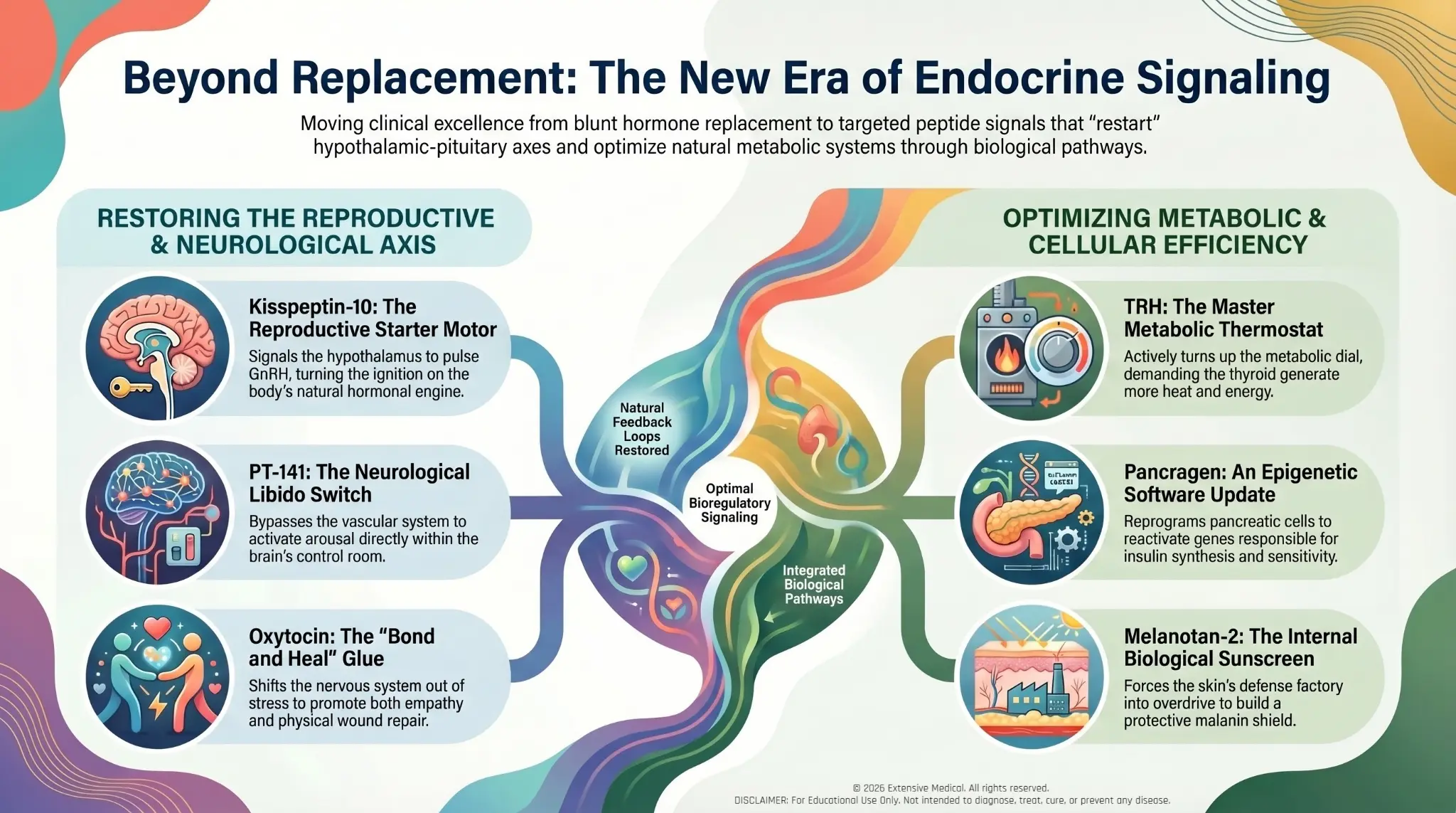
This module explores the sophisticated world of hormone and endocrine peptides. We shift from traditional hormone replacement — which forcefully shuts down the patient's natural production factories through negative feedback loops, creating lifelong dependency — to utilizing biological signaling to prompt the body to restore its own natural rhythms and endogenous hormone production. Seven precision therapeutics are covered.
Group Overview Infographic
Visual reference for all therapeutics in the Hormone & Endocrine group
© 2026 Extensive Medical. All rights reserved. For educational use by licensed healthcare practitioners only.
Therapeutics in This Group
Kisspeptin-10
Master Reproductive Hormone Regulator
Mechanism of Action
A naturally occurring neuropeptide produced in the hypothalamus that serves as the master regulator of the entire reproductive hormone axis. Binds to Kiss1R receptors to trigger a powerful, pulsatile release of GnRH (gonadotropin-releasing hormone), which then drives LH and FSH production.
Target System
Hypothalamic-pituitary-gonadal (HPG) axis — reproductive hormone cascade
Clinical Use
Used for hypogonadism, infertility, and hypothalamic amenorrhea — where the root cause is insufficient GnRH pulsatility rather than primary gonadal failure.
Key Benefits
- Restoration of natural GnRH pulsatility
- Increased LH and FSH production
- Improved testosterone and estrogen levels
- Fertility support
Key Differentiator
Targets the very top of the reproductive hormone cascade — the hypothalamic level — rather than replacing downstream hormones.
The Analogy
"Kisspeptin-10 is the ignition key for the entire reproductive hormone engine. It doesn't add fuel directly — it turns the key that starts the engine, allowing the body to generate its own fuel."
Gonadorelin
GnRH Analogue
Mechanism of Action
A synthetic analogue of gonadotropin-releasing hormone (GnRH) that directly stimulates the pituitary to release LH and FSH. Used in pulsatile administration to mimic natural GnRH signaling.
Target System
Anterior pituitary gland — LH and FSH production
Clinical Use
Used for hypogonadism, particularly in men on testosterone replacement therapy (TRT) to prevent testicular atrophy and maintain fertility.
Key Benefits
- Maintained testicular function during TRT
- Preserved fertility
- Natural LH and FSH stimulation
- Prevention of testicular atrophy
Key Differentiator
The standard of care for maintaining testicular function during exogenous testosterone therapy — a critical adjunct to TRT protocols.
The Analogy
"Gonadorelin is the backup generator for the pituitary's hormone production. When exogenous testosterone shuts down the natural signal, Gonadorelin keeps the downstream factories running."
PT-141
Bremelanotide — Melanocortin Receptor Agonist
Mechanism of Action
A synthetic analogue of alpha-MSH that activates melanocortin receptors (MC3R and MC4R) in the central nervous system. Unlike traditional erectile dysfunction drugs that work peripherally on blood vessels, PT-141 works centrally in the brain to activate the sexual arousal pathways.
Target System
Central nervous system — melanocortin receptor system
Clinical Use
Used for hypoactive sexual desire disorder (HSDD) in women (FDA-approved as Vyleesi) and erectile dysfunction in men — particularly in cases where PDE5 inhibitors have failed.
Key Benefits
- Central nervous system mechanism
- Effective for both men and women
- FDA-approved for HSDD
- Works when PDE5 inhibitors fail
Key Differentiator
The only sexual dysfunction therapeutic that works centrally through the brain's arousal pathways — not peripherally through blood vessel dilation.
The Analogy
"PT-141 is the brain's arousal switch — while Viagra opens the plumbing, PT-141 activates the desire circuitry in the brain that makes the plumbing relevant."
Oxytocin
The Bonding and Trust Neuropeptide
Mechanism of Action
A naturally occurring neuropeptide produced in the hypothalamus. Acts on oxytocin receptors throughout the brain and body to modulate social bonding, trust, stress response, pain perception, and uterine contractions.
Target System
Central nervous system and peripheral tissues — oxytocin receptor system
Clinical Use
Used for social anxiety, PTSD, autism spectrum disorder, sexual dysfunction, and as a bonding and trust enhancer in therapeutic settings.
Key Benefits
- Enhanced social bonding and trust
- Reduced anxiety and stress
- Improved pain tolerance
- Therapeutic applications in autism and PTSD
Key Differentiator
The only neuropeptide that directly modulates the social bonding and trust circuitry — a unique target not addressed by any other therapeutic class.
The Analogy
"Oxytocin is the brain's social lubricant — it reduces the friction in human connection by turning down the threat-detection system and turning up the trust and empathy circuits."
TRH
Thyrotropin Releasing Hormone
Mechanism of Action
A tripeptide produced in the hypothalamus that stimulates the pituitary to release TSH (thyroid-stimulating hormone), which then drives thyroid hormone production. Also has direct neuroprotective and mood-modulating effects independent of the thyroid axis.
Target System
Hypothalamic-pituitary-thyroid (HPT) axis and central nervous system
Clinical Use
Used for hypothyroidism, depression, and neurological conditions — particularly where restoring natural thyroid axis signaling is preferred over direct hormone replacement.
Key Benefits
- Natural thyroid axis stimulation
- Direct neuroprotective effects
- Mood modulation
- Restoration of natural TSH pulsatility
Key Differentiator
Works at the top of the thyroid axis (hypothalamus) and has direct CNS effects independent of thyroid stimulation — a dual-mechanism therapeutic.
The Analogy
"TRH is the thermostat controller for the body's metabolic furnace. Instead of manually turning up the heat (thyroid hormone replacement), it recalibrates the thermostat so the furnace regulates itself naturally."
Pancragen
Pancreatic Bioregulator
Mechanism of Action
A tetrapeptide bioregulator specifically designed for pancreatic tissue. Penetrates pancreatic cells and acts as an epigenetic tuner, restoring the natural gene expression of both exocrine and endocrine pancreatic cells — including the insulin-producing beta cells.
Target System
Pancreatic tissue — beta cell function and insulin production
Clinical Use
Used for age-related pancreatic decline, Type 2 Diabetes support, and as a preventive therapy for pancreatic dysfunction.
Key Benefits
- Restored beta cell function
- Improved insulin production
- Pancreatic tissue repair
- Epigenetic pancreatic restoration
Key Differentiator
Organ-specific epigenetic precision for the pancreas — targeting the beta cells that produce insulin at the genetic level.
The Analogy
"Pancragen is the software update for the pancreas — restoring the original code so the insulin-producing cells can read their youthful genetic blueprint and function at full capacity."
Melanotan-2
MT-2 — Melanocortin Agonist
Mechanism of Action
A synthetic analogue of alpha-MSH that activates multiple melanocortin receptors (MC1R through MC5R). Stimulates melanin production for UV protection, activates sexual arousal pathways (MC3R/MC4R), and reduces appetite through MC4R in the hypothalamus.
Target System
Melanocortin receptor system — skin, CNS, and hypothalamus
Clinical Use
Used for skin tanning and UV protection, sexual dysfunction, and appetite suppression — a multi-target compound with diverse clinical applications.
Key Benefits
- Melanin production and UV protection
- Sexual arousal activation
- Appetite suppression
- Multi-receptor targeting
Key Differentiator
A multi-target melanocortin agonist that simultaneously addresses skin protection, sexual function, and metabolic regulation through a single mechanism.
The Analogy
"Melanotan-2 is the multi-tool of the melanocortin system — one compound that activates multiple receptors to produce tanning, arousal, and appetite suppression simultaneously."
Medical Disclaimer: The information on this page is provided for educational and informational purposes only and is not intended as medical advice, diagnosis, or treatment. Statements regarding peptides and related compounds have not necessarily been evaluated by the U.S. Food and Drug Administration (FDA), and no claim is being made that any product or therapy referenced is FDA approved for the uses discussed. Always consult your licensed healthcare provider before starting, stopping, or changing any treatment, supplement, medication, or wellness protocol. Read our full Medical Disclaimer.