
Immune & Protective
Immune Modulation & Bioregulation
Immune Recalibration, Protection, and Bioregulation
Video Training — Group 5: Immune & Protective
Overview
This module covers the immune and protective peptide frontier. We shift from blunt immune suppression — heavy corticosteroids, biologics, and systemic immunosuppressants that leave patients vulnerable to infections and cancer — to utilizing biological signaling to recalibrate, instruct, and restore the immune system. We are not suppressing; we are modulating. Eight highly specific immune, protective, and bioregulatory therapeutics are covered.
Group Overview Infographic
Visual reference for all therapeutics in the Immune & Protective group
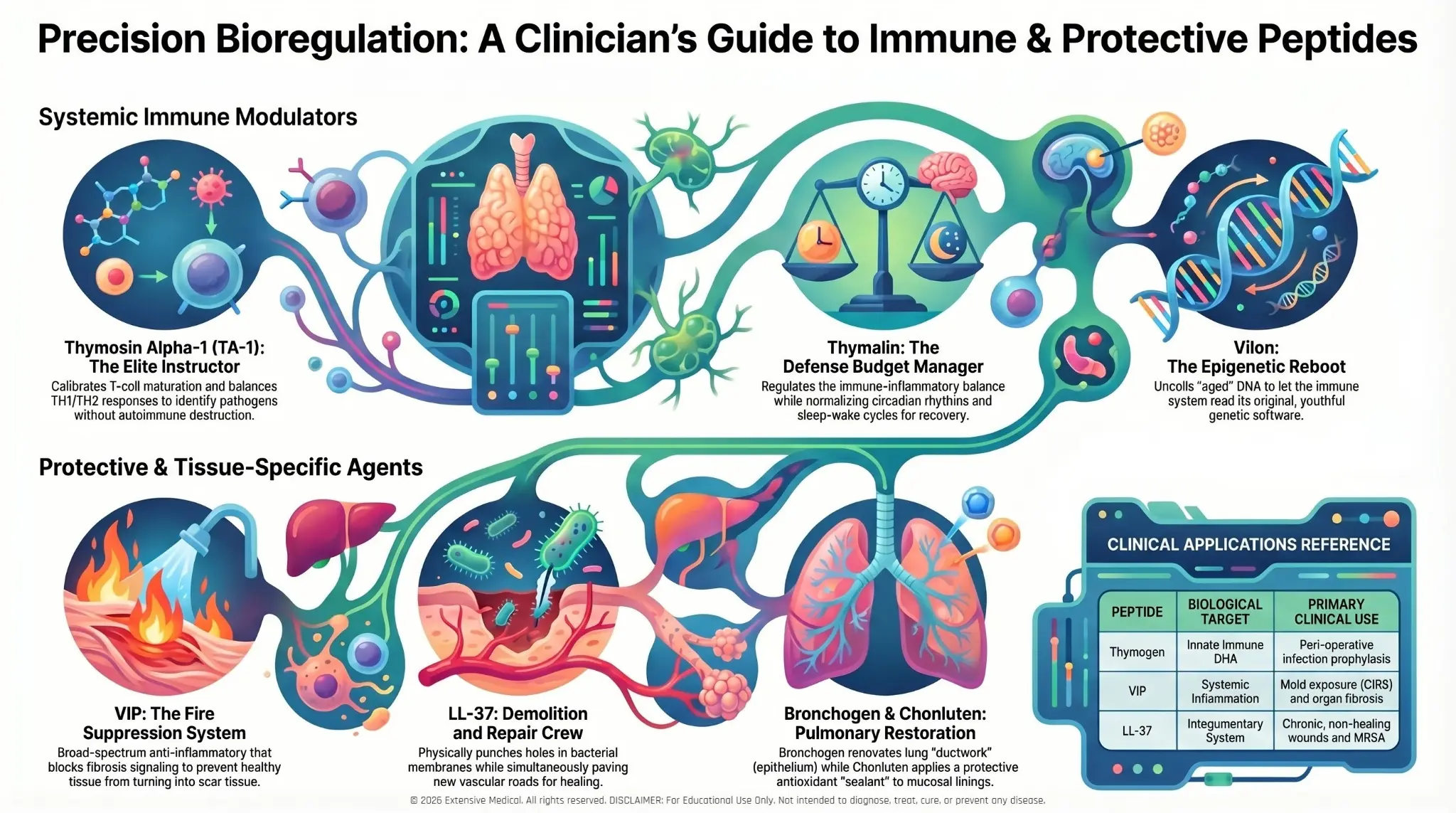
© 2026 Extensive Medical. All rights reserved. For educational use by licensed healthcare practitioners only.
Therapeutics in This Group
Thymosin Alpha-1
TA-1 — The Immune System General
Mechanism of Action
A naturally occurring 28-amino-acid peptide from the thymus gland. Acts as a powerful, precision modulator of systemic immunity — maturing and differentiating T-lymphocytes, increasing NK cell activity, balancing TH1/TH2 responses, and restoring the CD4/CD8 ratio.
Target System
Adaptive immune system, thymic networks, and cellular defense mechanisms
Clinical Use
Used globally as a critical adjunct in chronic viral infections, cancer immunotherapy, and immune deficiency states — particularly where the immune system needs calibration rather than blunt stimulation.
Key Benefits
- T-lymphocyte maturation and differentiation
- Increased NK cell activity
- Balanced TH1/TH2 immune response
- Documented survival improvements in oncology settings
Key Differentiator
A true immune modulator, not a blunt immunostimulant — makes the immune system highly active and vigilant without causing a hyper-inflammatory cytokine storm.
The Analogy
"TA-1 is the elite training instructor for the body's military academy. It re-opens the academy doors, organizing, training, and equipping the cellular defense team with better strategy, radar, and weapons."
Thymalin
Thymic Polypeptide Extract
Mechanism of Action
A polypeptide extract from the thymus gland that contains multiple bioregulatory peptides. Works broadly to restore thymic function and T-cell production — particularly in aging patients where the thymus has involuted (shrunk).
Target System
Thymus gland and T-cell production pathways
Clinical Use
Used for age-related immune decline, chronic infections, and as a broad immune restoration therapy in elderly patients with thymic involution.
Key Benefits
- Broad thymic restoration
- T-cell production support
- Age-related immune decline reversal
- Chronic infection management
Key Differentiator
A broad-spectrum thymic extract versus the highly specific single-peptide action of TA-1 — used when comprehensive thymic restoration is needed.
The Analogy
"Thymalin is like reopening and fully restaffing the immune system's training academy — bringing in the full faculty rather than just one elite instructor."
Thymogen
Thymagen — Dipeptide Thymic Bioregulator
Mechanism of Action
A synthetic dipeptide (Glu-Trp) that acts as a highly specific bioregulator for the thymus. Stimulates T-cell differentiation and maturation with high precision and minimal systemic effects.
Target System
Thymus gland — T-cell differentiation pathways
Clinical Use
Used for targeted T-cell restoration in patients with specific T-cell deficiencies, chronic viral infections, and post-chemotherapy immune recovery.
Key Benefits
- Highly specific T-cell stimulation
- Minimal systemic effects
- Post-chemotherapy immune recovery
- Targeted thymic bioregulation
Key Differentiator
A synthetic dipeptide with extreme specificity — the most targeted thymic bioregulator available, with a very clean side-effect profile.
The Analogy
"Thymogen is the precision scalpel of thymic bioregulation — a two-amino-acid key that opens only the T-cell production door, leaving everything else untouched."
Vilon
Dipeptide Immune and Longevity Bioregulator
Mechanism of Action
A synthetic dipeptide (Lys-Glu) that acts as an epigenetic bioregulator for multiple tissues including the immune system, vascular system, and aging cells. Activates telomerase and promotes cellular longevity.
Target System
Immune system, vascular system, and cellular aging pathways
Clinical Use
Used for broad immune support, vascular health, and as an anti-aging bioregulator — particularly in elderly patients with multiple system decline.
Key Benefits
- Broad immune and vascular support
- Telomerase activation
- Cellular longevity promotion
- Multi-system bioregulation
Key Differentiator
One of the few peptides that bridges immune modulation and cellular longevity — activating telomerase while supporting immune function.
The Analogy
"Vilon is the biological maintenance crew that services multiple systems simultaneously — immune, vascular, and cellular aging — in a single, ultra-short peptide."
VIP
Vasoactive Intestinal Peptide
Mechanism of Action
A 28-amino-acid neuropeptide that acts as a powerful anti-inflammatory and immune modulator. Binds to VPAC receptors to suppress pro-inflammatory cytokines, promote regulatory T-cells, and protect the gut mucosal barrier.
Target System
Immune system, gastrointestinal tract, and nervous system
Clinical Use
Used for autoimmune conditions, inflammatory bowel disease, pulmonary inflammation, and mast cell activation syndrome (MCAS).
Key Benefits
- Powerful anti-inflammatory effects
- Regulatory T-cell promotion
- Gut mucosal barrier protection
- Pulmonary inflammation reduction
Key Differentiator
A neuropeptide that bridges the nervous system and immune system — providing anti-inflammatory effects through a neuroimmune mechanism.
The Analogy
"VIP is the diplomatic envoy between the nervous system and immune system — it carries the message 'stand down' to overactive immune cells while protecting the gut's defensive walls."
LL-37
Cathelicidin Antimicrobial Peptide
Mechanism of Action
The only human cathelicidin — a naturally occurring antimicrobial peptide that directly kills bacteria, viruses, and fungi by disrupting their cell membranes. Also modulates the innate immune response and promotes wound healing.
Target System
Innate immune system and epithelial barrier function
Clinical Use
Used for chronic infections, antibiotic-resistant bacterial infections, wound healing, and inflammatory skin conditions.
Key Benefits
- Direct antimicrobial activity
- Broad-spectrum coverage (bacteria, viruses, fungi)
- Innate immune modulation
- Wound healing promotion
Key Differentiator
The only human cathelicidin — a natural antimicrobial that kills pathogens directly while simultaneously modulating the immune response.
The Analogy
"LL-37 is the body's own antibiotic that also doubles as an immune coordinator — it kills the invaders directly while calling in reinforcements and directing the cleanup crew."
Bronchogen
Lung Bioregulator
Mechanism of Action
A tetrapeptide bioregulator specifically designed for bronchial and pulmonary tissue. Penetrates lung cells and acts as an epigenetic tuner, restoring the natural gene expression of bronchial epithelial cells and reducing pulmonary inflammation.
Target System
Bronchial and pulmonary tissue — lung epithelial cell function
Clinical Use
Used for COPD, chronic bronchitis, pulmonary fibrosis, and age-related lung function decline.
Key Benefits
- Restored bronchial epithelial function
- Reduced pulmonary inflammation
- Improved lung capacity
- Epigenetic lung tissue repair
Key Differentiator
Organ-specific epigenetic precision — targets only the lungs, restoring their original genetic blueprint without systemic effects.
The Analogy
"Bronchogen is the lung's software update — it doesn't patch the symptoms, it restores the original operating code so the bronchial cells can function as they did when young."
Chonluten
Bronchial & Pulmonary Bioregulator
Mechanism of Action
A tripeptide bioregulator for bronchial and pulmonary tissue that works synergistically with Bronchogen. Specifically targets the regulation of mucus production and ciliary function in the bronchial epithelium.
Target System
Bronchial epithelium — mucus regulation and ciliary function
Clinical Use
Used alongside Bronchogen for comprehensive pulmonary bioregulation — particularly in patients with mucus hypersecretion and impaired mucociliary clearance.
Key Benefits
- Regulated mucus production
- Improved ciliary function
- Enhanced mucociliary clearance
- Synergistic with Bronchogen
Key Differentiator
Specifically targets the mucus and ciliary function of the bronchial epithelium — a complementary mechanism to Bronchogen's broader lung repair.
The Analogy
"Chonluten is the specialized maintenance worker for the lung's self-cleaning system — restoring the tiny cilia that sweep debris out of the airways and regulating the mucus that traps it."
Medical Disclaimer: The information on this page is provided for educational and informational purposes only and is not intended as medical advice, diagnosis, or treatment. Statements regarding peptides and related compounds have not necessarily been evaluated by the U.S. Food and Drug Administration (FDA), and no claim is being made that any product or therapy referenced is FDA approved for the uses discussed. Always consult your licensed healthcare provider before starting, stopping, or changing any treatment, supplement, medication, or wellness protocol. Read our full Medical Disclaimer.