
Growth Hormone & Muscle
Somatotropic Axis & Muscle Optimization
The Somatotropic Axis and Muscle Optimization
Video Training — Group 3: Growth Hormone & Muscle
Overview
This module covers the somatotropic axis — the chain of command from hypothalamus to pituitary to liver — and the peptide secretagogues that prompt the body's own pituitary gland to release natural, pulsatile growth hormone. We shift away from traditional synthetic HGH replacement, which forcefully overrides the body and suppresses natural pituitary function, toward biological signaling that teaches the body to remember how to function youthfully.
Group Overview Infographic
Visual reference for all therapeutics in the Growth Hormone & Muscle group
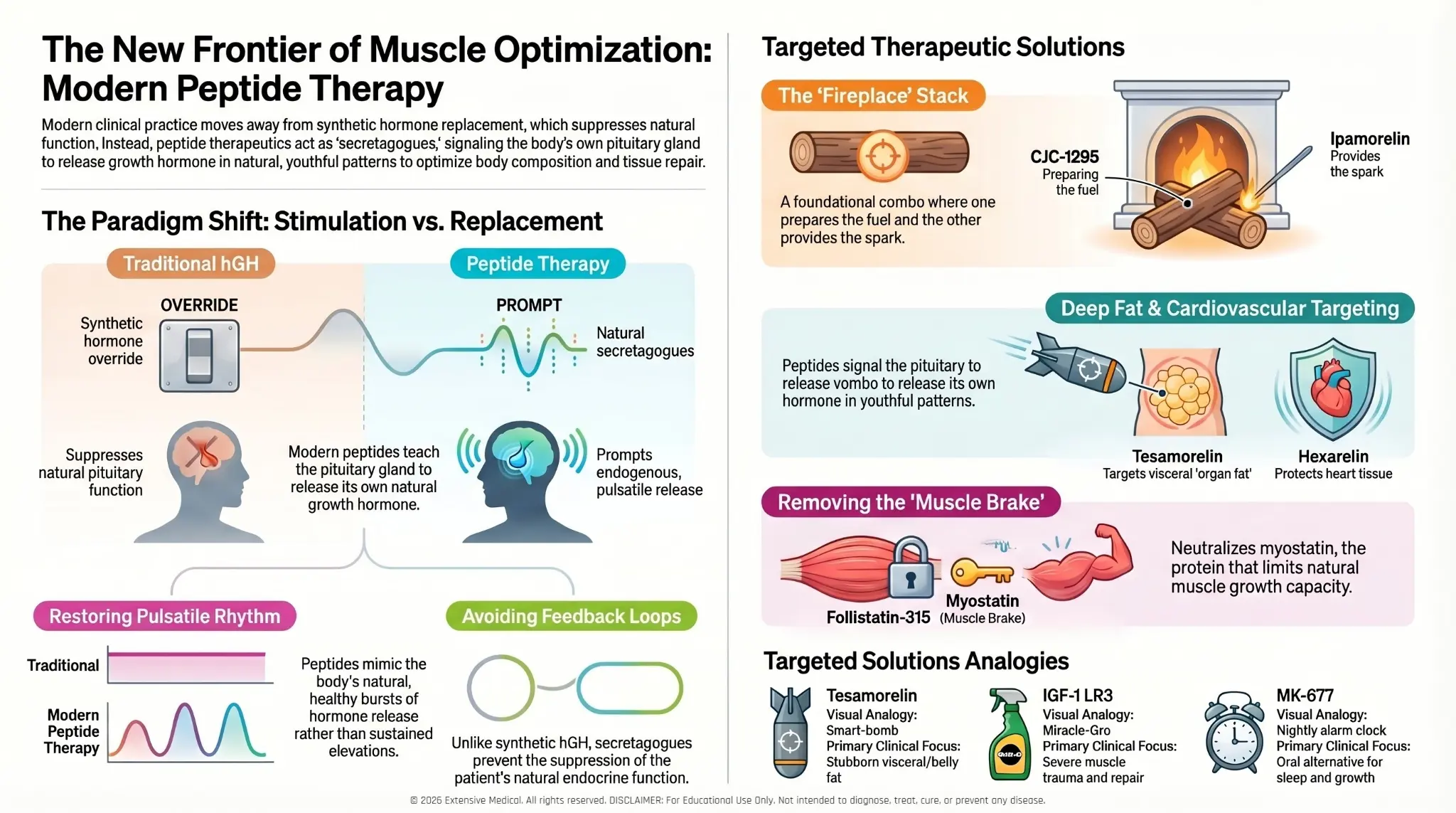
© 2026 Extensive Medical. All rights reserved. For educational use by licensed healthcare practitioners only.
Therapeutics in This Group
CJC-1295
Without DAC / MOD GRF 1-29
Mechanism of Action
Directly binds to GHRH receptors on the somatotroph cells of the anterior pituitary gland, sending a powerful signal to release a large pulse of growth hormone. It is the foundational half of the most popular growth hormone stack in regenerative medicine.
Target System
Anterior pituitary gland — GHRH receptor system
Clinical Use
Used to restore natural, pulsatile growth hormone release in patients experiencing age-related GH decline, poor sleep, muscle wasting, and metabolic slowdown.
Key Benefits
- Restored natural GH pulsatility
- Improved body composition
- Enhanced sleep quality
- Increased IGF-1 levels
Key Differentiator
Stimulates the body's own pituitary to release GH naturally rather than replacing it with synthetic hormone — preserving the natural feedback loop.
The Analogy
"CJC-1295 is the master key that unlocks the pituitary's production vault — it doesn't pour in synthetic hormone, it signals the factory to start producing again."
Ipamorelin
Selective GHRP
Mechanism of Action
A selective growth hormone releasing peptide (GHRP) that binds to the ghrelin receptor on the pituitary, amplifying the GH pulse triggered by CJC-1295. Critically, unlike older GHRPs, it does not significantly stimulate cortisol or prolactin.
Target System
Pituitary gland — ghrelin receptor system
Clinical Use
Most commonly stacked with CJC-1295 to create a synergistic, amplified GH pulse while maintaining a clean hormonal profile.
Key Benefits
- Amplified GH release
- No cortisol or prolactin stimulation
- Clean hormonal profile
- Excellent safety record
Key Differentiator
Highly selective — provides the GH-releasing benefits of older GHRPs without the unwanted stress hormone side effects.
The Analogy
"Ipamorelin is the amplifier in the GH release system — it turns up the volume on the signal sent by CJC-1295 without causing static (cortisol/prolactin) on the line."
Tesamorelin
GHRH Analogue — FDA Approved
Mechanism of Action
A stabilized analogue of Growth Hormone-Releasing Hormone (GHRH) that stimulates the pituitary to release GH. FDA-approved for HIV-associated lipodystrophy — the only GHRH analogue with this distinction.
Target System
Anterior pituitary gland and visceral adipose tissue
Clinical Use
Specifically prescribed for visceral adiposity — particularly HIV-associated lipodystrophy and metabolic syndrome with excess abdominal fat.
Key Benefits
- FDA-approved status
- Significant reduction in visceral fat
- Improved lipid profiles
- Preserved lean mass
Key Differentiator
The only FDA-approved GHRH analogue — providing regulatory legitimacy and documented clinical trial data for visceral fat reduction.
The Analogy
"Tesamorelin is the precision-guided missile of the GH secretagogue class — FDA-approved and specifically targeted at visceral fat depots."
Sermorelin
First-Generation GHRH Analogue
Mechanism of Action
A synthetic analogue of the first 29 amino acids of endogenous GHRH. Binds to GHRH receptors on the pituitary to stimulate GH release, with a shorter half-life than CJC-1295.
Target System
Anterior pituitary gland — GHRH receptor system
Clinical Use
Used as an entry-level GH secretagogue for patients beginning anti-aging or hormone optimization protocols.
Key Benefits
- Well-established safety profile
- Natural GH pulsatility
- Improved sleep
- Accessible entry point for GH optimization
Key Differentiator
Longer clinical track record than newer secretagogues — often used as a starting point before transitioning to more potent combinations.
The Analogy
"Sermorelin is the reliable, proven foundation of GH therapy — the first-generation tool that opened the door to the entire secretagogue class."
IGF-1 LR3
Long-Acting Insulin-Like Growth Factor-1
Mechanism of Action
Bypasses the brain entirely and binds directly to IGF-1 receptors on muscle, bone, and organ tissue. An extended version of natural IGF-1 with a half-life of 20-30 hours versus the mere 20 minutes of natural IGF-1.
Target System
Peripheral tissue — muscle, bone, and organ IGF-1 receptors
Clinical Use
Used when direct, localized tissue repair and muscle building is needed without waiting for the GH-to-liver-to-IGF-1 cascade.
Key Benefits
- Direct tissue-level action
- Extended half-life (20-30 hours)
- Localized muscle repair
- Bypasses pituitary-liver axis
Key Differentiator
Bypasses the entire GH-pituitary-liver axis — providing direct, immediate IGF-1 signaling at the tissue level.
The Analogy
"If growth hormone is the corporate instruction sent from headquarters, IGF-1 LR3 is the team of highly caffeinated field agents who show up directly at the construction site and start building immediately."
GHRP-2
First-Generation Growth Hormone Releasing Peptide
Mechanism of Action
A synthetic GHRP that binds to the ghrelin receptor on the pituitary to stimulate potent GH release. Stimulates cortisol and prolactin release as a side effect — a key differentiator from newer, cleaner GHRPs like Ipamorelin.
Target System
Pituitary gland — ghrelin receptor system
Clinical Use
Used for muscle loss, poor sleep, and GH optimization in patients who need strong GH stimulation and can tolerate some cortisol and prolactin elevation.
Key Benefits
- Potent GH release
- Muscle preservation and growth
- Improved sleep quality
- Well-documented efficacy
- Cost-effective
Key Differentiator
First-generation GHRP — highly effective GH stimulation with the trade-off of cortisol and prolactin co-stimulation. Stronger GH pulse than Ipamorelin.
The Analogy
"GHRP-2 is a heavy-handed doorbell ringer that wakes up the whole neighborhood — it gets the job done with maximum force, but it's not subtle."
GHRP-6
First-Generation GHRP with Appetite Stimulation
Mechanism of Action
A synthetic GHRP that binds to the ghrelin receptor to stimulate GH release, with a unique and pronounced appetite-stimulating effect via the ghrelin pathway. Like GHRP-2, it also stimulates cortisol and prolactin.
Target System
Pituitary gland and hypothalamic ghrelin receptor system
Clinical Use
Specifically indicated for cachexia, frailty, and severe lack of appetite accompanied by muscle wasting. The appetite stimulation that is a side effect in other GHRPs is a therapeutic tool here.
Key Benefits
- Potent GH release
- Intense appetite stimulation for cachexia
- Muscle wasting reversal
- Frailty support
- Well-documented efficacy
Key Differentiator
The only GHRP where appetite stimulation is a primary therapeutic benefit rather than a side effect — uniquely suited for cachexia and frailty patients.
The Analogy
"GHRP-6 acts as an internal dinner bell — ringing loudly throughout the body to stimulate hunger and simultaneously signal the pituitary to release growth hormone."
Hexarelin
Potent GHRP with Cardioprotective Properties
Mechanism of Action
One of the most potent GHRPs available. Binds to the ghrelin receptor for GH release but also uniquely binds to CD36 receptors in cardiac tissue, providing direct cardioprotective effects independent of GH release.
Target System
Pituitary gland and cardiac tissue
Clinical Use
Used for maximum GH stimulation and in patients with cardiovascular concerns who can benefit from the direct cardioprotective effects.
Key Benefits
- Maximum GH stimulation
- Direct cardioprotective effects
- Dual mechanism of action
- Cardiac tissue preservation
Key Differentiator
The only GHRP with documented direct cardioprotective effects through CD36 receptor binding — independent of its GH-releasing activity.
The Analogy
"Hexarelin is the Swiss Army knife of GHRPs — it releases GH through the front door while simultaneously sending a repair crew to the heart through a separate entrance."
MK-677
Ibutamoren — Oral GH Secretagogue
Mechanism of Action
A non-peptide, orally active ghrelin mimetic that stimulates GH release through the ghrelin receptor. Provides sustained, daily GH and IGF-1 elevation through convenient once-daily oral dosing.
Target System
Pituitary gland — ghrelin receptor system (oral administration)
Clinical Use
Used for patients who want the benefits of GH optimization without injections — particularly for anti-aging, sleep quality, and body composition.
Key Benefits
- Oral administration
- Sustained GH and IGF-1 elevation
- Improved sleep quality
- Increased muscle mass and reduced fat
Key Differentiator
The only orally bioavailable GH secretagogue — eliminates the need for injections while providing sustained GH elevation.
The Analogy
"MK-677 is the oral key to the GH vault — no needle required. It mimics ghrelin's signal to the pituitary through a simple daily capsule."
Follistatin-315
Myostatin Inhibitor
Mechanism of Action
A naturally occurring protein that acts as a powerful inhibitor of myostatin — the body's built-in brake on muscle growth. By binding to and neutralizing myostatin, it removes the biological ceiling on muscle development.
Target System
Skeletal muscle — myostatin signaling pathway
Clinical Use
Used for severe muscle wasting conditions (sarcopenia, cachexia) and in patients who need to maximize muscle preservation and growth.
Key Benefits
- Removes the biological ceiling on muscle growth
- Profound muscle mass preservation
- Synergistic with GH secretagogues
- Addresses sarcopenia and cachexia
Key Differentiator
Works through a completely different mechanism than GH secretagogues — removes the brake on muscle growth rather than pressing the accelerator.
The Analogy
"Follistatin-315 is the biological brake-release for muscle growth. Myostatin is the governor that limits how fast the engine can run — Follistatin removes that governor entirely."
Medical Disclaimer: The information on this page is provided for educational and informational purposes only and is not intended as medical advice, diagnosis, or treatment. Statements regarding peptides and related compounds have not necessarily been evaluated by the U.S. Food and Drug Administration (FDA), and no claim is being made that any product or therapy referenced is FDA approved for the uses discussed. Always consult your licensed healthcare provider before starting, stopping, or changing any treatment, supplement, medication, or wellness protocol. Read our full Medical Disclaimer.