
Energy & Metabolism
Cellular Fuel & Metabolic Optimization
Architectural Blueprints for Metabolic and Energy Peptide Therapeutics
Video Training — Group 1: Energy & Metabolism
Overview
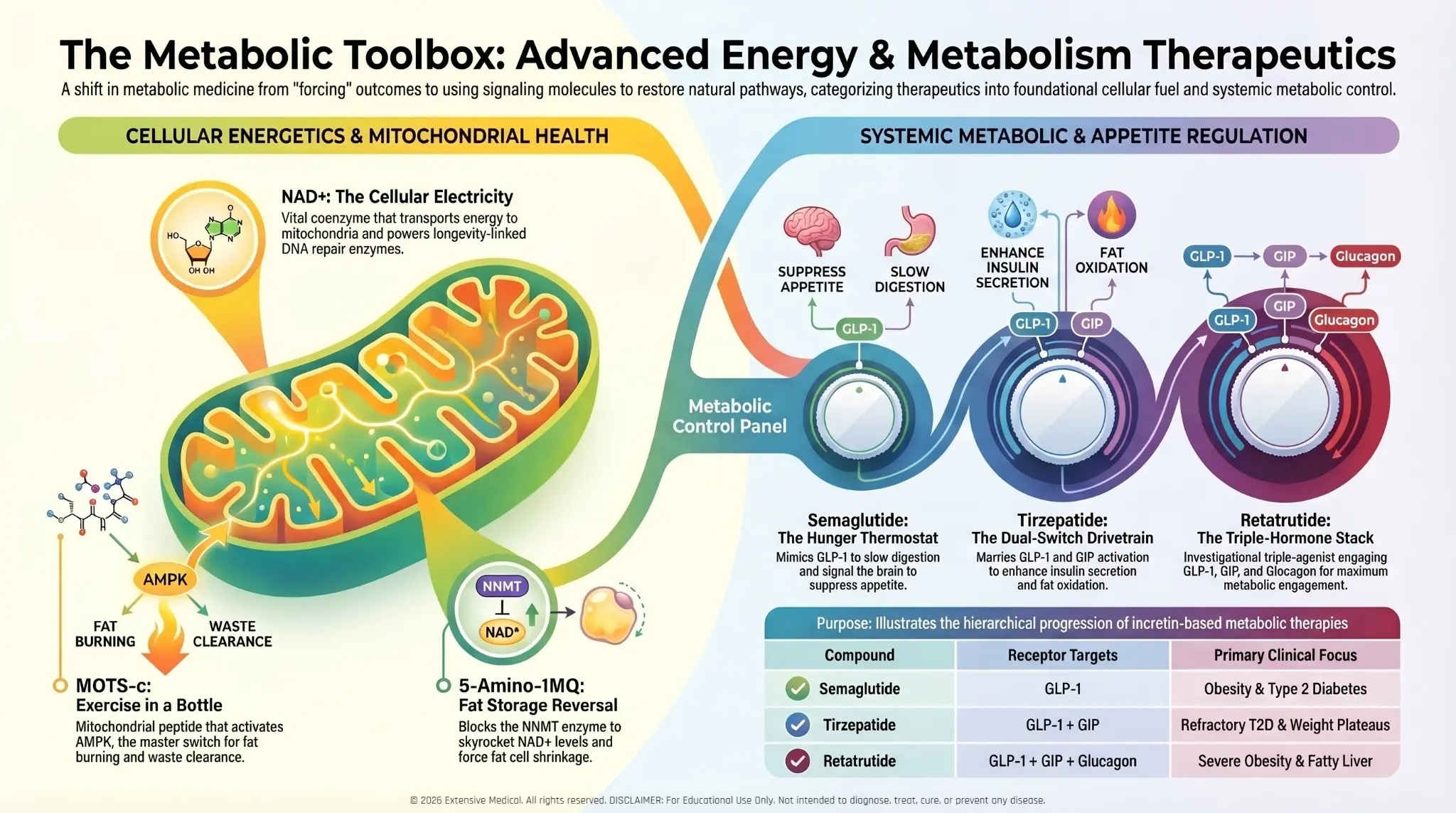
This module explores the architecture of cellular energy and metabolic optimization. We shift the narrative from 'forcing' a biological outcome — which attempts to override human physiology — to 'signaling,' which works harmoniously within existing biological pathways to restore function. Twelve specific metabolic and energy therapeutics are covered in detail, from foundational cellular fuel to advanced exercise mimetics.
Group Overview Infographic
Visual reference for all therapeutics in the Energy & Metabolism group
© 2026 Extensive Medical. All rights reserved. For educational use by licensed healthcare practitioners only.
Therapeutics in This Group
NAD+
Nicotinamide Adenine Dinucleotide
Mechanism of Action
Acts as a redox electron carrier, transporting energy from metabolized food to the mitochondria for ATP synthesis. Also serves as a mandatory co-substrate for Sirtuin longevity enzymes and PARP DNA-repair enzymes.
Target System
Cellular energetics, mitochondrial function, and genomic stability
Clinical Use
NAD+ levels decline steadily after the mid-thirties, leading to cellular fatigue, metabolic slowdown, and accelerated aging. Physicians prescribe NAD+ infusions or injections to restore the cellular engine.
Key Benefits
- Systemic cellular rejuvenation
- Improved mental clarity
- Accelerated recovery
- Profound DNA repair
Key Differentiator
It is the literal biochemical fuel required for life — it doesn't force the body to speed up, it gives the body the capacity to function optimally.
The Analogy
"NAD+ is like the electricity running through the wiring of a house. Every appliance depends on it. If the power plant output drops, the lights flicker and nothing works correctly."
NMN
Nicotinamide Mononucleotide
Mechanism of Action
A highly bioavailable derivative of Vitamin B3 that enters the cell and is rapidly converted directly into NAD+ through a short enzymatic metabolic pathway, raising systemic NAD+ levels from the inside out.
Target System
Cellular energy and longevity systems via the salvage and recycling pathways
Clinical Use
Provides the cellular benefits of NAD+ therapy through convenient daily oral, sublingual, or subcutaneous administration — without the clinical burden of long IV infusions.
Key Benefits
- Suppresses age-associated weight gain
- Improves insulin sensitivity
- Enhances aerobic capacity
- Daily compliance-friendly
Key Differentiator
Administration route and reliance on the body's internal conversion machinery, rather than flooding the system with the finished coenzyme.
The Analogy
"NMN is like premium-grade crude oil that your body's refinery directly converts into electricity. Instead of pouring raw electricity into a tank, you fill it with high-quality fuel and let the engine do the conversion."
Semaglutide
GLP-1 Receptor Agonist
Mechanism of Action
Mimics the natural GLP-1 hormone released after eating. Dramatically slows gastric emptying, prompts insulin release only when blood sugar is high, and crosses the blood-brain barrier to signal the hypothalamus to suppress appetite.
Target System
Gastrointestinal system, pancreas, and central nervous system
Clinical Use
Prescribed for Type 2 Diabetes and severe, diet-resistant obesity. Addresses the biological drive to eat at the neurological level, removing reliance on willpower.
Key Benefits
- Sustained fat loss
- Blood sugar control
- Reduced cardiovascular events
- Once-weekly injection
Key Differentiator
Requires only a once-weekly injection while providing massive weight loss alongside glycemic control — unlike older daily diabetic medications.
The Analogy
"Semaglutide acts as a chemical gastric bypass — it physically slows stomach emptying while sending a constant 'I am completely full' message directly to the brain."
Tirzepatide
Dual GLP-1 / GIP Receptor Agonist
Mechanism of Action
Combines GLP-1 receptor agonism with GIP (glucose-dependent insulinotropic polypeptide) activation. GIP works synergistically to further enhance insulin secretion, improve blood sugar clearance, and directly promote fat burning in adipose tissue.
Target System
GLP-1 and GIP biological systems
Clinical Use
Used for weight loss plateaus or refractory Type 2 Diabetes that does not fully respond to Semaglutide alone.
Key Benefits
- Greater weight loss than single-receptor agonists
- Comprehensive metabolic control
- Improved HbA1c
- Dual-pathway synergy
Key Differentiator
Doesn't just hit the pathway harder — it hits a second, complementary pathway simultaneously.
The Analogy
"If Semaglutide is upgrading a car's fuel efficiency, Tirzepatide is replacing the entire drivetrain. It rewires how the body handles fuel at two completely different points."
Retatrutide
Triple GLP-1 / GIP / Glucagon Receptor Agonist
Mechanism of Action
Next-generation triple-hormone-receptor agonist. Adds glucagon receptor activation to the GLP-1 and GIP benefits — directly increasing energy expenditure through thermogenesis and ramping up breakdown of stored fat in the liver and adipose tissue.
Target System
GLP-1, GIP, and Glucagon biological systems
Clinical Use
Investigational therapy for the most severe cases of obesity, fatty liver disease, and metabolic syndrome that resist all current treatments.
Key Benefits
- Weight loss exceeding 24% in 48 weeks
- Thermogenic fat burning
- Liver fat reduction
- Total metabolic reset
Key Differentiator
The thermogenic fat-burning effect driven by the glucagon component — patients burn more calories even while completely at rest.
The Analogy
"If Semaglutide is one metabolic switch and Tirzepatide is two, Retatrutide is throwing three switches simultaneously — engaging every single metabolic gear at once."
Cagrilintide
Long-Acting Amylin Analogue
Mechanism of Action
Mimics natural amylin, a hormone co-secreted with insulin by the pancreas after meals. Intensely slows gastric emptying, suppresses post-meal glucagon release, and directly regulates appetite centers in the brain.
Target System
Pancreatic and brain satiety signaling systems
Clinical Use
Almost always combined synergistically with Semaglutide to drive weight loss past the limitations of either compound alone.
Key Benefits
- Immense appetite suppression
- Liver protection
- Cardiovascular defense
- Non-redundant satiety mechanism
Key Differentiator
Operates on an entirely different biological pathway than incretin hormones — the perfect complementary therapy that doesn't compete for the same receptors.
The Analogy
"Cagrilintide is like adding a second, heavy-duty deadbolt to the refrigerator door. While Semaglutide makes your stomach feel full, Cagrilintide makes the very idea of eating more food feel genuinely unappealing."
Tesofensine
Triple Monoamine Reuptake Inhibitor
Mechanism of Action
Prevents the brain from clearing serotonin, norepinephrine, and dopamine. By keeping these chemical signals elevated in the brain's synapses, it powerfully suppresses appetite through multiple neurological pathways while increasing resting metabolic rate.
Target System
Central nervous system — brain reward centers
Clinical Use
Used for obesity refractory to gut-based therapies, particularly in patients who struggle with the psychological, emotional, and reward-based drive to overeat.
Key Benefits
- Rapid appetite suppression
- Elevated mood and focus
- Significant weight loss
- No GI side effects
Key Differentiator
Works exclusively through the central nervous system — addresses psychological craving and addiction to food directly at the neurological source.
The Analogy
"Tesofensine turns up three dials on a mixing board simultaneously: 'fullness,' 'satisfaction,' and 'energy.' With all three signals amplified, overeating becomes genuinely unpleasant."
AOD-9604
Modified HGH Fragment
Mechanism of Action
A synthetic peptide fragment of human growth hormone. Stimulates beta-3 adrenergic receptors on fat cells, triggering rapid lipolysis (fat release) while simultaneously blocking lipogenesis (new fat formation).
Target System
White adipose tissue metabolism and cartilage repair
Clinical Use
Prescribed for stubborn, localized adipose tissue and metabolic syndrome without the broader risks of full recombinant human growth hormone therapy.
Key Benefits
- Targeted fat breakdown
- Cartilage and osteoarthritis repair
- No effect on blood sugar or insulin
- No tissue hypertrophy
Key Differentiator
Isolates the fat-burning domain of human growth hormone while leaving the growth-promoting and insulin-disrupting domains behind.
The Analogy
"AOD-9604 is like using a highly specialized tool extracted from a massive toolbox — just the fat-burning wrench, with all the other tools left safely in the box."
MOTS-c
Mitochondrial-Derived Peptide
Mechanism of Action
A 16-amino-acid peptide derived from mitochondrial DNA. During metabolic stress, it travels into the cell nucleus, modifies the folate cycle to produce AICAR, which dramatically activates AMPK — the body's master metabolic switch.
Target System
Master energy regulation pathways — AMPK activation
Clinical Use
Prescribed for age-related metabolic decline, severe insulin resistance, and poor exercise capacity — especially in patients who cannot physically perform the exercise needed to trigger these pathways.
Key Benefits
- Restored metabolic homeostasis
- Inhibited myostatin for muscle preservation
- Enhanced physical performance
- Exercise mimetic effects
Key Differentiator
Acts as a true 'exercise mimetic,' producing the exact molecular and cellular adaptations that intense physical exercise normally would.
The Analogy
"MOTS-c is an emergency signal flare launched from the power plant (mitochondria) directly to City Hall (nucleus), demanding activation of new, highly efficient energy protocols."
SLU-PP-332
ERR Pathway Activator
Mechanism of Action
Selectively activates estrogen-related receptors (ERR-alpha, beta, and gamma) in skeletal muscle and metabolic tissues, driving a massive increase in energy expenditure, fatty acid oxidation, and mitochondrial function.
Target System
Skeletal muscle and metabolic tissues via ERR pathways
Clinical Use
Used in advanced metabolic protocols where increasing baseline fatty acid oxidation and rebuilding mitochondrial output in skeletal muscle is the primary objective.
Key Benefits
- Forces muscles into high fat-burning capacity
- Biologically identical to elite aerobic conditioning
- Increases mitochondrial density
- No mechanical loading required
Key Differentiator
Specifically activates ERR pathways to drive energy expenditure, focusing heavily on skeletal muscle adaptation — distinct from MOTS-c's AMPK pathway.
The Analogy
"SLU-PP-332 acts as a perfect biological simulation of a marathon — tricking the body's internal machinery into believing the muscles are undergoing hours of rigorous endurance training."
5-Amino-1MQ
NNMT Inhibitor
Mechanism of Action
Specifically blocks the NNMT enzyme in white adipose tissue. By blocking NNMT, it prevents NAD+ depletion in fat cells, causing NAD+ to skyrocket locally — increasing the local metabolic rate, activating SIRT1, and forcing fat cells to shrink and release stored contents.
Target System
White adipose tissue — NNMT enzyme and NAD+ pathways
Clinical Use
Used for diet-resistant obesity and age-related metabolic syndrome in patients who have optimized lifestyle but still cannot lose fat due to stubborn cellular metabolic roadblocks.
Key Benefits
- Direct reduction in fat mass
- Reversal of diet-induced obesity
- Enhanced cellular longevity
- Works without massive dietary changes
Key Differentiator
Works by removing a physical biochemical roadblock to fat loss rather than just suppressing appetite in the brain.
The Analogy
"5-Amino-1MQ fires the corrupt fat-storage manager inside the cells who has been hoarding all the energy. Once that manager is fired, the cells immediately start releasing what they have stored."
JBSNF-000088
Advanced NNMT Inhibitor
Mechanism of Action
Another potent NNMT inhibitor that prevents NAD+ depletion and reduces toxic metabolic byproducts. Acts as a massive, specific driver for insulin sensitization and profound glucose modulation.
Target System
Metabolic regulation systems — NNMT enzyme and insulin sensitivity
Clinical Use
Used for severe, systemic metabolic disease — particularly advanced obesity paired with dangerous insulin resistance induced by long-term poor dietary patterns.
Key Benefits
- Normalizes glucose tolerance
- Significant body weight reduction
- Profound synergy with NAD+ precursors
- Anti-inflammatory and anti-aging activity
Key Differentiator
Profound synergy when stacked with NAD+ precursors like NMN — together drastically altering energy metabolism while boosting anti-inflammatory and anti-aging activity.
The Analogy
"JBSNF-000088 is a heavy-duty biological filter that scrubs out years of metabolic sludge, fundamentally restoring the engine's sensitivity to fuel."
Medical Disclaimer: The information on this page is provided for educational and informational purposes only and is not intended as medical advice, diagnosis, or treatment. Statements regarding peptides and related compounds have not necessarily been evaluated by the U.S. Food and Drug Administration (FDA), and no claim is being made that any product or therapy referenced is FDA approved for the uses discussed. Always consult your licensed healthcare provider before starting, stopping, or changing any treatment, supplement, medication, or wellness protocol. Read our full Medical Disclaimer.